Thursday, September 14, 2017

A (nicely executed) revolution in the theater


In my not-so-humble opinion, one mark by which to judge the success of a playwright's work is whether or not it stimulates a theatergoer to think about or research the topics or characters discussed or featured therein. And that's precisely what happened last weekend after I attended a performance of Lauren Gunderson's "The Revolutionists" at Ann Arbor's spunky Theatre Nova.

For despite a few minor quibbles on my part, Gunderson's very creative, yet dark comedy about the French Revolution and its Reign of Terror - which starts with the sound of a guillotine, of all things - intrigued me enough to send me to my computer to learn more about the four women she brings together for an imagined encounter, which led to my uncovering a treasure trove of information a history lover like me will drool over for days.

And what interesting women they were!

In her play, Gunderson imagines what might happen if a controversial French feminist playwright is visited by a civic-minded murderess-to-be, a free black woman activist from what's now known as Haiti, and a well-known and somewhat-ditsy queen at a time when France was in the midst of major, world-changing cultural and political turmoil. All are there for reasons of their own, yet each is requesting the services of the playwright to create for them what could be their exit line from this mortal plane. (I won't spoil it for you, but since three of the characters are based on actual historical figures, quick research will reveal their fates and whether or not the statements were needed.)

The result is a script that is oftentimes quite witty (some of which seemed to go over the heads of the audience on the night I was there), yet cognizant of the perils these brave women faced. The carefully crafted dialogue is crisp, sharp and intelligent throughout, with each character carefully drawn and fully realized. And by play's end we certainly know who these women are, what they believe and how they fit into French society.

And how dangerous it was for a woman to speak out on the issues of the day!

However, I walked away from the performance unsure of and a little puzzled by what Gunderson's goal truly was. Is "The Revolutionists" a piece of artistic naval-gazing in which the playwright ponders the power of the written play and what impact such work may or may not have on society? Or is it a feminist manifesto (or propaganda piece) in which a light is shined on all of the world's ills then and now (from gender inequality to the wealth gap, and from privilege to slavery), yet with no message other than it would be a different world if women were in charge?

Was it a mix of the two? Or better yet: Did I simply miss the point?

What I didn't miss, though, was the performance everyone who has seen the show is raving about. After an astounding solo performance last year in Theatre Nova's production of "Katherine," 2016 Wilde Award nominee Melissa Beckwith returns with another tour de force, playing the historical Marie Antoinette. I've been a fan of Beckwith's work since I first saw her on the The Ringwald stage many years ago (or was it its progenitor, Who Wants Cake, at that point?), and she still has the chops to surprise and impress me. From the moment she first enters to the show's final moments, Beckwith fills the character with the larger-than-life traits one expects of this historical figure, yet with an emotional underpinning that reveals a depth and awareness one may not expect. If there's a performance to beat this season, this is it.

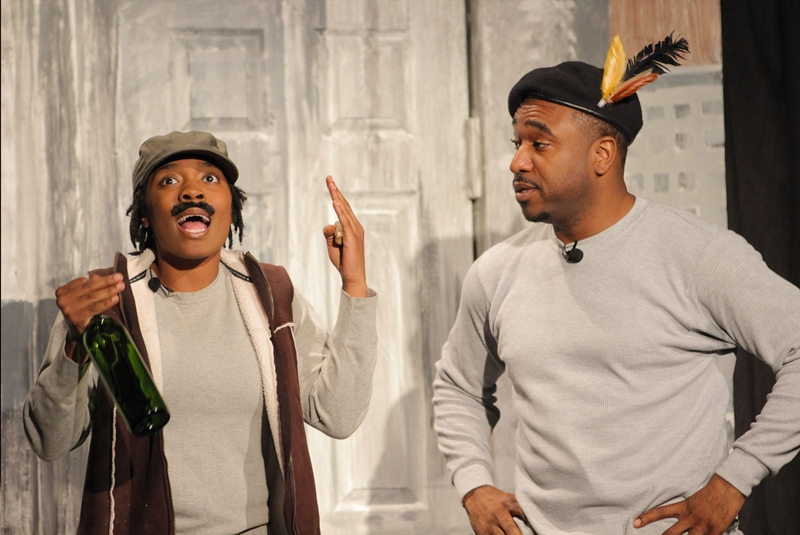
Also featured in the show are K Edminds as Marianne Angelle, Diane Hill as Olympe De Gouges, and Sara Rose as Charlotte Corday.

As fellow critic Jenn McKee stated in her review, "The Revolutionists" is a play that can't help but remind me of the productions staged by the now-defunct and very missed Performance Network, especially when director David Wolber and founding artistic director Carla Milarch were running things. (The only difference is the budget for the set, which I suspect would have been much higher in the good ol' days.) And that's high praise indeed!

THE BOTTOM LINE: I wouldn't be surprised if this weekend's closing performances will be sold out, so if you'd like to catch the show, I recommend you reserve your tickets now! You won't be disappointed!

For complete show details, CLICK HERE!


Sunday, September 3, 2017

A life's menagerie on display at Slipstream

Bailey Boudreau and Steve Xander Carson


A few weeks ago, as I was interviewing University of Michigan undergrad and up-and-coming playwright Maxim Vinogradov about his new work, A Night of Stars with Tennessee Williams that's now onstage at Ferndale's Slipstream Theatre Initiative, I couldn't help but think, "I've gotta check this show out." And that's what I did this past Saturday night - and I left afterwards impressed by both his script and the work of the actors who brought this difficult, yet intriguing story to life.

Set some undisclosed years after his death, Williams now holds court in Purgatory where he gives daily lectures to his fellow "residents" who want to hear stories about the playwright and his many famous friends. These chats, it seems, cover the same territory as the typical gossip magazine found on newsstands both then and now - which means nothing too personal and nothing too serious is discussed.

Tonight, however, is different, thanks to malfunctioning gadgetry Williams and his assistant, Edwina, use during his presentation. (To show you how well thought out this production is, the tech is consistent with what Williams would be familiar with during his lifetime.) So rather than the typical laugh-filled romp through his well-publicized life and times, Williams is instead forced to face some rather unpleasant thoughts and memories he'd rather keep hidden.

Purgatory, it seems, is not what Williams was expecting.

The play itself, however, surpassed my expectations.

Vinogradov - whose script has already been blessed with two impressive writing awards through U-of-M's prestigious Hopwood competitions - tackles his subject with a sharp scalpel, expertly scraping away layer upon layer of the persona Williams created for himself and the public. But the truth hurts, as the saying goes, and Vinogradov's extensive research and careful plotting help us to better understand the man behind the myth and how his inner demons played out in the stories he told upon the stage and silver screen - many of which we still cherish more than three decades after his death.

The result is a powerful tale well told - and a very human one.

But it's also a bitch to stage well and convincingly, as most of his characters are the famous and infamous whose voices, images and mannerisms are burnt into our collective memories.

And so choices have to be made: How far does the director go - in this case, Vinogradov co-directed the show with Victoria Rose Weatherspoon - in recreating these colorful characters?

Wisely, the co-directors kept the characters grounded in reality, never allowing them to rise to the point of caricature. Instead, each actor found the flavor of their characters through hours of research that they then used to build their interpretations.

That's especially visible when you watch Ryan Ernst as Truman Capote. Although he'd never appear in my Top Five Hundred People To Play Capote list - the two men are polar opposites in pretty much every way conceivable - the role affords Ernst a meaty opportunity to grow, expand and mature as as actor, and he certainly rises to the opportunity by capturing the idiosyncratic author's vocal characteristics and mannerisms quite well. But equally important is the dignity and respect he shows his character by portraying him as realistically as possible when it would be far easier to resort to stereotypes.

Another fascinating performance is given by Slipstream heart throb Steve Xander Carson. Playing the role of Williams' handsome, longtime lover Frank Merlo, Carson slips onto the stage as if he stepped out of a 1950's Life magazine and strikes a pose that would be familiar to anyone familiar with publications that catered to gay men of that era.

I could go on and on about the show's many fine performances, including Jan Cartwright as Edwina and Tiaja Sabrie as Williams' sister Rose (who will break your heart). And continuing its endeavor to give high school students a chance to earn some real-life stage experience while on their summer vacation, recent Wilde Award winner Jackson Abohasira captures a young Brando quite nicely, while Grace Jolliffe's Garbo and Hepburn made me smile, for example.

But the toughest nut to crack is that of Williams himself. He was a complicated man in real life with demons who haunted him till his death, and it's a many-layered role that runs the gamut of emotions. it's a role that took Slipstream artistic director Bailey Boudreau out of his comfort zone - so much so, he kept trying to get out of it. But Vinogradov would not hear of it, and he pressed the actor to keep at it.

To say that Boudreau succeeded would be an understatement. He too showed significant growth as an actor in this production, and his (and the show's) final 10-15 minutes will leave your heart in your throat and you'll be speechless as the lights go down for the last time.

That's how powerfully good this production is. And I predict great things will be forthcoming from the talented Mr. Vinogradov!

A Night of Stars with Tennessee Williams runs through Sept. 17. For show details, CLICK HERE!

To read my preview of the show, CLICK HERE!

Maxim Vinogradov and Bailey Boudreau


Monday, April 24, 2017

When faced with tough choices: How producers make decisions when blessed with great options

Center: Adriane Galea, surrounded by playwrights
 Michelle Jane Wilson, Matthew Buckley Smith,
Lewis J. Morrow and Jeff Stolzer

Seeing five shows over two days can be a bit much - even when those plays are presented as staged readings. But I couldn't resist when Adriane Galea afforded me the opportunity to serve as a judge at Outvisible Theatre Company's first-ever New Works Festival this past weekend in Allen Park.

As long-time readers may recall, I consider it a great honor to both call attention to and discuss the work of talented up-and-coming playwrights, as well as offer my thoughts on new plays staged by our theaters. And I've been blessed to share whatever insights I've had on dozens of new plays written by an ever-growing cadre of local playwrights whose work has graced our stages.

But Outvisible's festival was somewhat surprising, as out of the 320 or so scripts submitted, all five chosen were from playwrights outside Michigan. And even more surprising, four out of the five playwrights were in attendance.

The response was not what Adriane, Outvisible's founder and executive director, was expecting. But it turned out to be quite an event, as the subjects of the play were as different from one another as they could possible be. And the playwrights, as equally different as the works, were all enthusiastic participants in the lively discussions that followed each performance, each willing to consider the feedback they received.

Although some last-minute cast changes resulted in a handful of uneven performances, each of the five plays was well received by the audience. Two are ready to be fully produced, in my humble opinion, while two require only minor adjustments. And as Adriane told me during the festival, the plays she liked best after initially reading them were replaced by others once they got on stage.

That, in a nutshell, is the value of such a festival. Although the scripts aren't fully produced but staged with only one or two rehearsals, the concept allows both playwrights and producers to see what works and what doesn't, what makes sense and what doesn't, and what needs fixing and what doesn't. In other words, staged readings serve two basic purposes: to give playwrights an opportunity to receive a professional reading of their work, and to provide producers a chance to assess how successful a script may be if added to their schedule.

For Adriane and Outvisible, this was a festival blessed with literary riches - which made it quite difficult to choose a winner (which would ultimately be given a full production at some point in the next season).

So what was the ultimate factor that determined which play would be chosen? It simply came down to one thing: Outvisible's performance space.

Now in its inaugural season, Outvisible performs in an intimate, black-box space the size of a living room found in a typical 1950s ranch. As such, plays that require elaborate sets and scene changes are difficult to manage, and even a half-dozen actors on stage at the same time would be far too much of a crowd to adequately move around in a meaningful way.

And so with that in mind, Adriane's decision came down to this: Which of a handful of excellent possibilities would work best in her space.

And the winner was Unsportsmanlike Conduct by New York-based Jeff Stolzer, a decision I fully supported.

But what of the others? Personally, I can think of a handful of theaters where The One Difference by Lewis J. Morrow would be a perfect fit. (It's also immediately ready to be produced.) Likewise, once a few script changes have been made, Matthew Buckley Smith's The Major, The Minor, The Living, The Dead and Michelle Jane Wilson's That's Him would work quite well at several local theaters. The trick, now, is to introduce these playwrights to the appropriate artistic directors to see if they can make theatrical magic together.

I hope that happens.  Soon.

To find out more about Outvisible Theatre Company, click here.

PS: In a conversation after the festival, it was fun to discover that Minnesota-based playwright Michelle Jane Wilson is actress Inga Wilson's aunt. It IS a small world after all!


Saturday, April 22, 2017

Chilling story, excellent performances in Williamston


You know an audience is captivated by and fully engulfed in a performance when an audible gasp or the sound of air being sucked out of the room is heard every time a character is subjected to a round of torture. And that was certainly the case at last night's performance of the excellent 1984 at Williamston Theatre whenever Winston Smith (played with horrifying accuracy by actor David Wolber) is given an electric shock to teach him the error of his ways - especially throughout the second act's climactic moments.

Wolber's is but one of several spot-on perfect performances in director Tony Caselli's dark, scary and thought-provoking production of George Orwell's famous 1949 novel that's received a lot of attention in recent months thanks to one of the most contentious presidential elections of my lifetime. And while Michael Gene Sullivan's adaptation captures the book's high points quite well (from what I can remember; I last read the book about 40 years ago), what I watched most closely and was most fascinated by were the facial expressions and body language expressed by each of the characters throughout the performance.

Why? Because Caselli, who's received 13 Wilde Award nominations for his past directorial efforts and earned five wins, is among the elite handful of directors I've observed over the years who digs deeply into his scripts with a fine eye towards discovering the subtleties and nuances planted in the script by the playwright. And then he works closely with his actors to use what he's found to add to the complexities of their performances.

And that's certainly what happened with 1984, as it's not always what's said that matters, but rather what's occurring in the minds of the various characters. That's especially true of the show's final moments. Are some of the party members beginning to see through the lies they've been told by Big Brother? Have the seeds of doubt been planted for a future revolution?

Catch one of the show's final performances this weekend and look closely at the faces of the Party Members. And notice their body language: Has anyone's changed since the show's first act?

And see if you agree that John Lepard - one of the community's nicest guys, in my opinion - isn't one scary dude in this show!

The Bottom Line: Dramas have become few and far between in recent years (although the trend has been changing a bit recently), but if you like challenging work that makes you think about the issues being addressed long after the curtain comes down, I strongly suggest you check out this production.

1984 closes April 23. Production details can be found here.

PS: To help drive an earlier point home, it should be noted that Caselli is currently the #1 recipient of Wilde Awards in the state, with a total of seven. Yeah, he's that good!


Sunday, April 16, 2017

No mess, just a fine-tuned production at Theatre Nova


Since the start of the new year, a handful of shows have generated a high level of "buzz" in the community. "It's a 'must-see' show" I've heard several times, and when I checked them out, they were indeed correct - which helped prove what I've maintained for many years now: that Southeast Michigan is blessed with an abundance of high quality theater.

One show in recent weeks seemed to rise above the rest, however, and luckily I was able to catch it on its closing weekend at Theatre Nova.

Clutter, playwright Brian Cox's first full-length play, explores a familiar, time-tested concept - "the battle of the sexes," as it used to be called - but does so by taking it apart and reshaping it into a gutsy, thoughtful and thought-provoking examination of one couple's deteriorating marriage through the recollections of the husband.

Even the form Cox chooses to tell his memory play is unique, as the husband (referred to simply as "Me") - telling his story directly to the audience - chooses two people seated in the house (called "Woman" and "Sir") to help bring his memories to life. It's a concept fraught with danger, however, as the characters slip back and forth from past to present and from their "actual" selves to Me's memories, the result of which could be very disjointed and confusing. But in the hands of Diane Hill, making an impressive directorial debut since joining Theatre Nova as a producing artistic director a handful of months back, every moment is precision tooled to keep the timeline clear and the plot focused.

Equally focused are Tory Matsos and Artun Kircali as Woman and Sir. Although they are portraying characters who talk but rarely communicate with one another, the two are in total sync with each other throughout their fully believable performances. Their tell-tale eyes, their subtle movements, and their revealing facial expressions all add multiple levels of depth and color to Cox's words and characters, thereby allowing the audience to better understand the complex nature of their relationship.

But most impressive is Phil Powers as Me. For several years, Powers seemed to be stuck in roles needing a strong utility player - that is, someone to come in, play a supporting role, knock it out of the ballpark, and then go home. As such, he was never the star, didn't received much acclaim, but was nonetheless appreciated for the caliber of his work. (Or is my memory faulty about the past, like his character's is in the play?) But when offered an opportunity to dig into a meaty role, Powers excelled, the result of which earned him four Wilde Award nominations and one win (which was, to me, his breakout role in Performance Network's The Drowsy Chaperone). In Clutter, Power invests every emotion imaginable into his character, so much so that I'm not sure how he pulls it off night after night and not go home mentally exhausted - especially following the emotionally draining final minutes of the show.

With so much to chew on, playwright Cox and his co-conspirators deliver theatergoers with something few plays offer: hours of follow-up, and likely lively, discussion. That's especially true of the bombshell they drop as the show moves into its homestretch, the ramifications of which are not addressed. But they were in the car on our way home.

The Bottom Line: Clutter is my type of theater: thoughtful script, powerful performances, and plenty of meat for continued discussion long after the performance is over.

Unfortunately, Clutter closes April 16. Performance details can be found here.


Saturday, April 15, 2017

Damn, that Detroit musical was fun!


In recent decades, it's been easy to take potshots at Detroit; pretty much everyone's done it at some point over the years, residents and pundits alike, and much of it was deserved. But rarely have they been hurled with as much comedic insight and love for the city as can be found in The Detroit Musical about to conclude its run at the new Ant Hall in Hamtramck.

Originally titled Detroit Be Damned: A Beaver's Tale when it premiered in 2010 at Planet Ant (and subsequently at the Park Bar), co-creators Mikey Brown and Shawn Handlon have updated their popular production that views the city's 300-plus-year history through the eyes of the LeMerde family, who were among the area's original French settlers. (Look up a translation of their last name and you'll discover just how sneaky and subversive Brown and Handlon are at carefully threading the show together with even the most seemingly innocent reference.)

Beginning with explorer Antoine Laumet de La Mothe, sieur de Cadillac's arrival by canoe in 1701, the well-researched musical comedy touches upon many of the significant moments in the city's history - including the known and not-so known (Oscar Meyer lived and worked in Detroit? Who knew!), as well as the good, the bad and the "just for the fun of it." (So, yes, it makes total sense to include the friendly rivalry between the American and Lafayette Coney Islands downtown, although to me the constant negative description of food from one of the two venues comes across as more of a personal vendetta against the place than anything else.)

While not every poke or jab is as sharp or works as well as the cast and creators would like, the overall result is an often side-splitting romp, thanks to sharp and witty dialog, with expertly crafted video (by Brown) and delightful tunes (words by Brown and director Handlon; music by the multitasking Brown) helping to set the time, place and plot pieces needed to move the story along. (I bet everyone hums The Livonia Song - a catchy ditty about white flight - at some point after the performance; it's the highlight of the show.)

Five actors portray the show's numerous characters, with only an article of clothing or head piece to distinguish one from another. (They're mostly related, after all.) Chris Korte and Dez Walker return from previous incarnations of the show (always a major plus), joined by Stefanie Bainter, Rj Cach and Paris Mason. Together, the ensemble is equally adept at delivering the comedy as they are the songs, with the two women especially strong in the vocals department. (The recorded music sometimes overpowered the singers, however.) And every time the handsome and clean-cut Cach walked on stage, I couldn't help but think there's a production of The Book of Mormon in his future.

The Bottom Line: For me, The Detroit Musical represents one of the things I love most about our local professional theaters - especially the smaller houses: They're willing to take chances and explore themes and concepts their bigger brothers and sisters wouldn't touch. And as patrons, we're lucky to have such talented creators living and working here, creating original works of such high quality. So while The Detroit Musical isn't perfect (and what is?), it sure is one helluva fun show!

The Detroit Musical closes April 15. For show details, click here.

PS: Here's one fact the show's creators failed to include in their script: A certain cranky critic is a direct descendant of one of Detroit's original 300 families. Yes, my roots here are deep - and my family tree includes more than a few colorful characters. But we lasted within the city limits longer than the LeMerdes did: through 1995 when my mother passed away and we sold the house she lived in for a few months shy of 50 years.


Saturday, April 8, 2017

Eye-popping puppets teach life lessons at Boll Theatre


The inner child in me bubbled to the surface with excitement this past Thursday evening once the music started for The UDM Theatre Company's performance of Avenue Q.

You see, I love puppets and art of puppetry. I was lucky to grow up during the period I've often heard referred to as "the golden age of puppetry." In those early days of local children's television programming, the airwaves were chock-full of puppets every weekday morning (Sagebrush Shorty; Woodrow the Woodsman; The Friendly Giant) and afternoon (Lunch with Soupy; Jingles in Boofland; Captain Jolly), with national broadcasters getting into the act with personal favorites such as The Shari Lewis Show, The Paul Winchell ShowHowdy Doody and Kukla, Fran and Ollie.

There were many others, of course, including The Ed Sullivan Show, which often showcased the work of international puppeteers and ventriloquists. (Remember Topo Gigio and Senior Wences?) But among them all, the creative genius of one artist stood out from the other acts, and once his characters were featured daily on Sesame Street - and later, their own show - all the other puppeteers and beloved characters were pretty much broomed into the dustbin of history. That's how great Jim Henson's Muppets were, as they became the standard by which the art form would now be judged.

That's a lesson I learned the hard way as a producer in the late 1970s and early '80s. As a big-time puppetry fan (and puppeteer), I specifically included original puppet shows in the early seasons of my professional touring educational theater company. Although they initially sold well, the feedback we received - and the subsequent drop in bookings - proved what our audiences told us: "They're not the Muppets."

Flash forward to 2008 and the arrival of the much ballyhooed Avenue Q at Detroit's Fisher Theatre. Often referred to as "Sesame Street for adults" (despite the lack of authorization from Henson and the Sesame Workshop), I couldn't wait to see the show. Would it be like visiting old friends, I wondered?

Adult friends, yes; these aren't the puppets of my youth. And I wasn't disappointed. Nor was I disappointed by my return visit to the famous street this past Thursday.

The musical is a modern-day coming-of-age tale in which the show's early-adult characters ponder their lives and futures. (Sounds familiar, right?) But it does so in a format reminiscent of TV's Sesame Street, mixing live characters and puppets who use songs and flashy video to move the story along.

But unlike Sesame Street, Avenue Q is for grownups, not kids. Plus, the puppeteers are in full view of the audience, which presents a unique challenge to any theater that produces the show.

And it's on that basis that I judge every performance I see of Avenue Q: How well do the puppeteers do their job of convincing me they aren't there, and that the focus is on the puppet and not its manipulator?

For the most part, The Theatre Company actors do quite well in this regard.

Especially notable is Ashlee Armstrong, who plays Kate Monster. A professional puppeteer with Detroit's internationally renowned PuppetART, every movement is well defined, and Kate's mouth moves in total synch with the dialogue. And she's also mastered the art of never taking focus away from the puppet.

Also delightful is Joel Frazee's performance as Princeton. In particular, his voice is perfect for the character, and it never fades throughout the show. But because he is so animated in bringing the character to life, I did find myself watching him at times rather than the puppet.  (His facial expressions are priceless.)

The remaining puppeteers all do fine jobs, as do the three "live" actors who seamlessly interact with their furry and fuzzy neighbors. Especially noteworthy is Michael Adams as Gary Coleman - yes, that Gary Coleman. If you didn't know better, you'd swear he is the pint-sized, but now-grownup star of Diff'rent Strokes.

Musically, the voices are strong and blend well. And I'd swear there were more than four musicians producing the music, that's how great the accompaniment is under the baton of Dan Greig.

But at one point in Act Two, a weariness seemed to set in and the cast's otherwise close attention to detail seemed to fluctuate - so much so, that certain characters' mouths didn't move when they were speaking.

Direction is by Greg Grobis, with set design by Melinda Pacha (my favorite of hers so far this season).

The Bottom Line: I guarantee you'll leave the show humming a tune or two - IF you can still find a ticket! But be forewarned: Rough puppet sex can be harmful to the eye! (That's a reference only those at Thursday's performance will appreciate!)

Avenue Q runs through April 9 at the Marlene Boll Theatre downtown. Show details can be found here: