Wednesday, September 1, 2021

As Village Players reopens, love (and virus protocols) are in the air


From unexpected storms and fires to sudden illnesses and tragic deaths, producers of live theater have faced and responded to numerous crises over the past several decades. Sure, they may have had to temporarily pause performances for a day or two, immediately recast a role, or cancel the remaining run of a show. But not since the early 20th century have producers faced a major pandemic, especially one that shut down much of the world for a year and a half. So not only could their shows not go on, entire seasons had to be scrapped and theaters had to lock their doors as COVID-19 raced across the country.

In response – and to keep connected to their audience base – some producers offered theater-starved patrons fresh content via video. Others eventually moved outdoors with socially distanced performances. But now, as many companies throughout Metro Detroit begin announcing their seasons (all the while keeping their fingers crossed they’ll actually happen), one brave community theater, The Village Players of Birmingham, is among the first (if not the first) to unlock its doors, dust off the stage and invite patrons back into its performance space.

It was not an easy decision to make.

“It required several meetings of the Safety Committee, their recommendations to both the artistic and business boards, and approval of the boards to proceed with the upcoming slate of shows,” explained Stephen Sussman, the Players’ artistic board president. “There were several months of meetings and planning before proceeding.”

The Safety Committee, Sussman said, consisted of the troupe’s house and grounds chairperson, various long-time members, a doctor, a nurse (also members) and Sussman, an architect who is familiar with all aspects of the physical plant. “Using guidelines established by the CDC and State of Michigan, we decided it was safe and appropriate to start to have indoor live performances.”

Business as usual would not be the case, however. The first row of seating was removed, for example, to create more physical space between the stage and audience seating. But that’s not all. “(The) cast and crew are required to be vaccinated and show proof of vaccination,” Sussman explained. “When offstage, cast members are encouraged to wear masks. All audience members are urged to wear masks when in the playhouse. There is no gathering inside during intermissions and after performances for the audience to greet cast members; that is done outdoors. And we are suspending all afterglows for the time being.”

The Village Players tested the waters last month with a production of the musical “Godspell” that ran for one weekend only. Although one might think it would have been difficult to cast thanks to COVID-related hesitancy, Sussman said that wasn’t a significant factor. The real challenge was to find cast members who were able to rehearse and perform during the summer. “This is always a challenging time to find actors and participants due to vacations, travel, and other summer activities.”

There was a minor concern, however, with the vaccination requirement during auditions that was addressed. “The result was a fabulous show that was of high quality and that the audiences absolutely loved,” he said. “(Patrons) were thrilled to have live performances back.”

Sussman was also pleased with the box office numbers. “Ticket sales were surprisingly good for a summer show that ran for only one weekend - Thursday through Sunday -  and was not part of the original slate. And since this was an additional show to welcome our members and patrons back, we consider it a huge success.”

Also successful were the new COVID protocols. “I’d guess we had about 98 to 99% compliance,” Sussman continued. “Almost everyone wore a mask during the show and were very cooperative. There were a few people – very few – who resisted wearing a mask. They claimed they were vaccinated, however. I presume those that weren’t comfortable simply didn’t attend. So short of having an actual mandate, I think we are comfortable with the policies we have currently in place.”

After such promising results with “Godspell,” The Village Players now turns its focus on its next show, which will be the first to run a traditional, multi-week schedule since the theatre shut down mid-run in March 2020 because of state-mandated COVID restrictions. And if the title rings a bell, it should.

“Shakespeare in Love” was the production shuttered after only three performances, and its return this month makes total sense to Sussman. “It is a fantastic show, and since the set was still in place and the majority of the actors were even now interested in performing it again, it was an easy decision to start the season with this restaging,” he said.

A few actors needed to be replaced, however. Not because of COVID concerns, but due to moving away or scheduling conflicts. “No one that was available refused to participate.”

For director Holly Hellsten Conroy, neither wild horses nor a mutating virus could keep her from returning to the show. “‘Shakespeare In Love’ is my baby,” she explained. “I’d worked on it for more than two years prior to that first production. So much of my heart is in this project; there was no way I’d drop the ball. Beyond my own love of the show, the enthusiasm of our cast and crew to return to the stage sealed the deal.”

And with safety protocols in place, Conroy said she feels safe. “Any hesitancy I might have felt disappeared once I received my second vaccination.”

Because the world has radically changed, so too has the working environment. Rehearsals and performances are now part of an experimental brave new world to which actors and audiences alike will have to adjust and make allowances. “Although our actors will not be wearing masks onstage during performances, we’ve allowed them to wear masks during rehearsals for their own comfort,” Conroy said. “Obviously, with part of the face covered, I’m apt to be directing what I hope is there. Fortunately, the two principal characters in our production are played by a very talented married couple – Ashley and Patrick Lane – who have no need of masks.”

Actress Lane, who plays Viola, had few qualms about returning to the show. “I have the same nerves that I am sure many have when jumping back into group activities,” she said. “It feels strange to be in groups and close to people again, when for so long we held back from those activities. However, after the initial nerves, I have felt very comfortable and grateful for the experience!”

Why? “(Both the production team and the Safety Committee) are constantly updating and changing the policies to ensure that we are following the state’s guidelines and recommendations in real time. There are physicians as part of the safety committee who have firsthand experience and knowledge of COVID, so that helps make me feel very well taken care of in this setting.”

But what happens when audiences enter the mix? “There is always the slight fear that the more people you encounter, the greater the risks are, but again, I feel very confident in the producers and the safety committee to ensure that everyone is being informed and taken care of in every way possible,” Lane said.

Similar reactions are found among the tech crew. “I was never hesitant to get involved,” said props mistress Suzie Skibicki. “I was part of our production before we were shut down by Covid last year and was thrilled to be able to return to my post for a full run of the show. I am eager for our patrons to share a live theater production with us,” she said.

So too is Ashley Lane. “We need theater!” she exclaimed. “I think the world needs art and human stories now more than ever. We need to come together and remember that at our core, we are all the same. We laugh, we cry, we are all human! There is a lot of division in the world, and I believe that theater unites us. So I hope that this production can bring a little bit of unity to our corner of the world right now.”

But that’s not all. “Our industry has been hit in a devastating way from COVID, as many industries have been, and I feel as an artist it is my job to bring stories back to our audiences, in a safe way of course. Especially in such times of uncertainty and anxiety, sharing the human experience through a play is extremely healing.”

But will audiences show up? “I am concerned that patrons will fear attending an indoor event and we might have small audiences,” director Conroy said. “It’s such a splendid show and everyone has worked so hard on it, it deserves sold-out performances.”

Patrons will be asked to wear masks, even if they’re vaccinated, although the theater won’t police it, Conroy noted.

And if they do show up, what will patrons be treated to? A romantic comedy, according to board president Sussman, that’s even funnier than the Oscar-winning motion picture it’s based upon. “We have a wonderfully talented cast, and there are beautiful period costumes, live Renaissance music and dancing, sword-fights and even a dog!”

In other words, there’s pretty much something for everyone in The Village Players’ production of “Shakespeare in Love.”

And who couldn’t use a good laugh these days?


Shakespeare in Love
The Village Players of Birmingham
34660 Woodward Avenue, Birmingham
Sept. 10, 11, 17, 18, 24, and 25 at 8 p.m.
Sept. 12, 19, and 26 at 2 p.m.
Tickets: $20 (plus a $1 processing fee for each ticket order)
Purchase online at www.birminghamvillageplayers.com or by calling the theater box office at 248-644-2075.

Note: Anyone with questions regarding the Players’ COVID policy can find the most up-to-date information on its website at www.birminghamvillageplayers.com.

Above photo caption: Romantic sparks fly on and off the stage as married couple Ashley and Patrick Lane star in "Shakespeare in Love."  Photo: Joseph Lease


About The Village Players:
The Village Players of Birmingham, a 501 (c)(3) nonprofit community theater, presents high quality dramatic, comedic, and musical productions. Everyone is invited to participate on stage, backstage or as an audience member in the theater's main stage, youth theater, and Playwrights at Work productions and programs. The Village Players have been entertaining the community from its location at 34660 Woodward Avenue in Birmingham since 1926.

Saturday, June 12, 2021

A powerful, affecting theatrical team up


They had me at Payton and Kelley. Richards and Hill. Briggs and DeBruyne. Theatre Nova and The Ringwald.

Since the 1970s, comic book fans have been treated to the occasional intercompany crossover in which DC produced a story featuring Superman with Marvel’s Spiderman, while Marvel and IDC mixed it up with the X-Men and Star Trek. (Yes, that really happened.) Part of the fun for the reader was seeing how writers and artists of one company would mix with their peers and/or characters of another to churn out a story that could be enjoyed by fans of both.

A somewhat similar phenomenon occurred across the Detroit-to-Lansing corridor since at least 2005 when the late, lamented BoarsHead Theater joined forces with Plowshares Theatre Company to co-produce “The Story,” which was quickly followed by other team-ups with Meadow Brook Theatre and (the equally late and lamented) Performance Network. And it wasn’t long before a handful of other theaters joined in the fun.

As a theatergoer, I always looked forward to these events, since the cross pollination of talent served to introduce audiences in one market to the creative wizardry of another. They also enabled budget-wary producers to share costs that allowed two companies to offer quality shows to their specific audiences they might never otherwise experience. (If, for example, Performance Network and BoarsHead hadn’t co-produced Kim Carney’s “Moonglow,” most theatergoers in Metro Detroit might never have been treated to the wonderment that was the amazing actress, Carmen Decker.)

It was a win-win for everyone, including the multitude of actors, designers and directors whose options for work increased because of this exposure to management teams outside their traditional venues.

Unfortunately, such joint efforts seemed to have fallen by the wayside in recent years – and the pandemic shutdown certainly put a stop to them altogether. But an email I received a few weeks back gave me hope that team-ups and crossovers will make a comeback as theaters begin to slowly reopen their doors to the public.

The good news is that the first such effort is well-worth seeing. Given the show’s pedigree, I assumed the production would be well cast and creatively staged. What I didn’t expect, however, was how such an OK script could become so much more powerful and memorable because of their efforts.

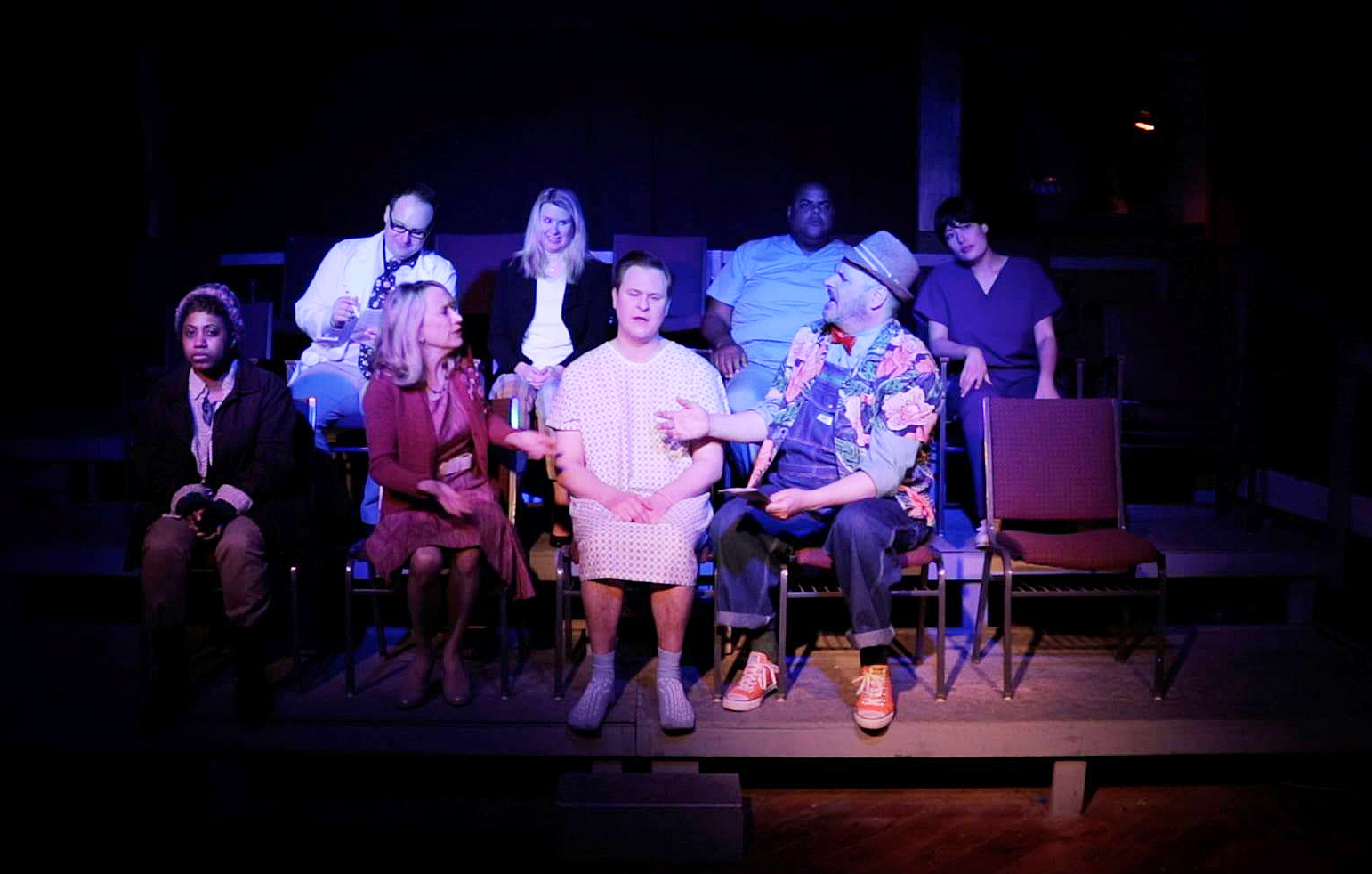
For three weekends beginning June 5, Ann Arbor’s Theatre Nova and (the still-in) Ferndale’s Ringwald Theatre began “on-demand” performances of the musical “A New Brain,” courtesy of Broadway on Demand. It can be accessed any number of ways online through June 20. The production is the best of both worlds, as it’s staged as a play, but produced as a movie, which brings the power of the performances up close and personal in a way that would never happen sitting three (or 20) rows from the action. And that made all the difference in how I responded to the production.

Creator William Finn initially conceived “A New Brain” not as a musical, but as a series of songs he wrote after being released from the hospital following his near-fatal collapse on 45th Street in New York City. After workshopping what started as a concert-style production, Finn teamed with frequent collaborator James Lapine on the book, and together they merged the songs with a storyline to create a 90-minute (or so) musical that launched off-Broadway in 1998 for an almost five-month run.

It’s a somewhat-autobiographical tale. Children’s television songwriter Gordon Schwinn is frustrated creating silly songs for a demanding adult man dressed as a frog. While having a not-so-pleasant lunch with his best friend and agent, Gordon’s brain decides to painfully introduce him to a heretofore-undiscovered arteriovenous malformation, sending Gordon face first into his meal. Later, at the hospital awaiting brain surgery, Gordon reveals his biggest fear: dying with his greatest song still inside his head. And it just so happens that his boss, Mr. Bungee, still needs one more tune for the next show. Immediately.

There’s much more to it than that, with most of the plot and story revealed through song rather than dialog. Sometimes, though, you might scratch your head and wonder why a homeless lady keeps showing up, or why the show occasionally feels like a patchwork of songs that kinda/sorta don’t feel connected. Or why the characters seem a bit shallow, one-note or cartoony, with motives that aren’t always clear.

But none of that is the fault of Theater Nova or The Ringwald. What they are responsible for, however, is director Vince Kelley and his cast taking Finn and Lapine’s material and making it – well, sing!

And sing they do. Diane Hill as Gordon’s neurotic mother, Mimi, has two numbers that sizzle. The first, “Mother’s Gonna Make Things Fine,” is Mimi’s initial reaction to her son’s hospitalization. But with the realization that Gordon’s surgery could be fatal – and outside her ability to fix – she decides to head over to Gordon’s apartment and clean. It’s a heart-wrenching performance, as Mimi’s emotions bubble up and explode – and it serves as a reminder of just what a kick-ass actress Hill is in such roles.

Then there’s Jamie Richards as Mr. Bungee, the tyrannical producer and star of the children’s television show that employs Gordon as a songwriter. One image burned into my memory bank is Richards as a contemplative Mr. Bungee, sitting in his darkened studio, a cigarette dangling from his lips. As played by Richards, his number, “Don’t Give In,” is especially revealing. (Richards is another whose character work is always top-notch.)

A pleasant surprise was the inclusion of popular actor Steve DeBruyne in the production. His is a voice I could listen to all day, and he has plenty of fun with the role of Doctor Berensteiner. And I absolutely laughed out loud at an aside inserted into the script in which he plugs with a quick wink and a nod his own theater company. (That would be The Dio – Dining & Entertainment in Pinckney; check it out when it reopens.)

Others in the cast are Jason Briggs as sympathetic (and handsy) nurse Richard, who knocked me out in “Ain’t Misbehavin’” at the Jewish Ensemble Theatre in 2019. Here, he’s the show’s comic relief and the lone voice of compassion, and he lights up the stage whenever he’s the focus of a scene. Arielle Crosby likely has the strongest, sweetest and most polished singing voice in the show, and she’s a delight in the role of Lisa the homeless woman. Alaina Kerr is perfectly annoying as the waitress whose jabbering helps initiate Gordon’s attack, and later, as mean nurse Nancy. Then there’s Liz Schultz as manager/best-friend Rhoda, a character who simply helps move the story and songs along but doesn’t really contribute much of importance to the plot. (It’s a fine performance in an otherwise un-notable role.)

Most impressive, however are longtime friends and collaborators Richard Payton as Gordon and Vince Kelley as Richard, Gordon’s boyfriend. The two certainly up their already incredible game here, as we watch both individually and together sort through their strained relationship and come out better at the end. But be forewarned: Keep your Kleenex ready, as the power of video closeups magnifies and personalizes their story far better than a stage play ever could. As the saying goes, they “keep it real” – and as such, their audience has ringside seats as the couple’s emotions seep through the lyrics and dialog, and as a result they create real, struggling, and loving people we can identify with as they work through a scary time in their lives.

Staging, camerawork and editing are very good, with only a few minor bumps and bruises along the way (mostly as one scene moves to the next). But it’s a far superior viewing experience than any Zoom production I’ve seen. And lighting effects are an especially notable part of the storytelling, particularly when it comes to Mr. Bungee. (Pay close attention to find out why.)

Will you be able to hum a tune from the show after turning off your computer? Probably not. But you will remember the journey of Gordon and Roger, thanks to Richard and Vince, who tug and tear your heart before sewing it back together with performances both men should be quite proud of.


SHOW INFORMATION: Remaining show dates on demand are June 12, 13, 19 and 20. Tickets are $25 per person. Purchase tickets HERE.

FOR MORE INFORMATION: www.theatrenova.org/

Read a preview in Between The Lines: CLICK HERE!


Monday, April 19, 2021

The Ringwald lovingly 'spears' entertainment icons in video murder-mystery


 Have you been missing visits to your local professional theaters as much as I have?

As the pandemic shutdown is now in its second year, theaters across the country are both hopeful that reopening day is not far off, yet fearful their very existence may be in jeopardy before that much-anticipated. For some theaters, this has meant going totally dark and off the radar until it’s safe to invite guests back into their facilities; companies such as Theatre Nova, Open Book Theatre and a handful of others, however, have embraced 21st-century technology and created occasional video and zoom productions to stay connected to their patrons.

And while watching plays on a TV or computer screen isn’t as intimate or as fun as sitting mere feet away from live actors in a darkened theater, tough times require innovation – but what does that means for the industry once the world returns to some semblance of normal? Unfortunately, we won’t know for some time to come. Will the habits of former patrons be changed to the extent that video will now be their preferred entertainment medium? Will customers be slow to return – if at all? Will a mix of live and recorded entertainment packages be the new “thing” for industry producers in the years and seasons to come?

We’ll see. But for now I’m thrilled to get my occasional fix from producers such as The Ringwald Theatre, who continue to offer patrons what they do best and with the talent audiences have grown to love, with only the medium and the method of delivery changed.

So what little treat do the creative and innovative folks at The Ringwald have in store for us this time? How about an original comedy that oddly (but successfully) combines one of TV’s most beloved sleuths and a troubled pop star in a tale that could have been ripped from supermarket tabloid headlines, “Murder, She Podcast: Baby One More Crime.”

In a 21st-century update to the traditional TV whodunnit, famed mystery novelist Jessica Fletcher investigates the strange disappearance and possible murder of Brittany Spears - and once again her old friend, (former) Sheriff Amos Tupper, is at her side. Now, though, they are interviewing witnesses via the internet from inside her home in Cabot Cove where they are recording the latest episode of their weekly podcast series. Assisting them is producer Andrew Lark.

To be honest, much of pop culture flies below my radar, especially anything to do with Hollywood and recording artists. So I’m about as familiar with the trials and tribulations of this faded singing sensation as I am with the lives of my neighbors six doors down – meaning, I know their names and what they do for a living, but that’s about it. Yet, the well-plotted script by the returning team of Vince Kelley and Matthew Arrington provides all the details and background info I needed to follow – and enjoy – the story, thanks in part to the snark, asides and snappy quips that are quite useful in providing this necessary information. (And what’s said is often funny as heck, too!)

What also works extremely well is the use of technology to tell the story. As written, “Murder She Podcast” would never work as a stage play. And so director Brandy Joe Plambeck and video editor Dyan Bailey utilize the creative tools of modern-day videography to effectively move the plot along. Especially fun are Tupper’s dream sequences in which he ponders the details of each suspect’s role in the possible murder of Ms. Spears. (And that’s all I’ll reveal. Why ruin the surprise for you!)

Most impressive, though, are the performers. In typical Ringwald fashion, a few genders are bent to great effect, and together, each actor (bent or otherwise) takes the words the authors gave them, grabs them by their metaphorical balls, and has a blast delivering very memorable (and spot-on) characters.

That’s especially true of Donny Riedel as the “Leave Brittany Alone” girl, Chris Crocker. Compare his interpretation here to the video of Crocker you can find online and you’ll be even more amazed by his stunning performance.

Another standout is the infectiously delightful Nicole Pascaretta as bubbly and wide-eyed younger sibling Jamie Lynn Spears. I don’t know how close on the mark her portrayal is – remember, my knowledge of such people is almost nil – but I loved every minute she brightened my screen!

Also loads of fun is regular Ringwald character actor Joel Mitchell, who is pitch perfect (isn’t he always?) as hardware store cashier Gene Smart, who just might have some light to shed on a purchase that could lead to identifying the killer. And Cory Shorter is delicious as Brittany’s hairdresser, Jeffrey Bean, who may reveal a heretofore secret that could help crack the case. Or maybe not.

Then, of course, there’s Richard Payton, once again donning dress and wig, this time as Jessica Fletcher; Joe Bailey as Cabot Cove’s beloved Sheriff Tupper (seasons one through four only, though, as Jessica reminds him); and Suzan M. Jacokes as put-upon producer Andrew Lark (who often accomplishes more with a devastating expression than any word ever could). These three are a seamless team, each playing to the others’ strengths and obviously having a ball doing so!

And as a result, I had one heck of a ball, as well!

But there’s one more performance I’ve yet to mention, and I’ve saved the most intriguing for last. Of all the actors one could think of to play Brittany Spears, the choice by director Plambeck is one that would never appear on most anyone’s list – not even in the last, oh-hell-no position. Yet the decision to cast Dave Davies in the role was a brilliant one. Not only is he one of the funniest, most talented and nicest guys you’d ever want to know, I’ve now learned you can “doll him up” and make an amazingly cute girl out of him! The only crime committed here was that we didn’t see more of her.

Oh - and one final note: As every movie seems to do these days, make sure you stay tuned after the credits for a bonus presentation. It's an original music video, and you'll love it!

* * * * *

SHOW INFORMATION: Tickets for Murder, She Podcast: Baby One More Crime are available at www.theringwald.com at three different giving levels: $20, $50, and $100 and can be purchased now through Sunday, May 2. The performance will be available to stream through May 10. Once you purchase your ticket, an email will be sent to you which will include links for Murder, She Podcast: Baby One More Crime and a virtual program. The video is hosted on Vimeo. You can watch on your phone/computer/tablet or, if you have the capability, you can stream the production to your smart TV.

NOTE: "Murder, She Podcast: Baby One More Crime" was developed prior to the release of the Framing Britney Documentary. The Ringwald firmly stands in support of the pop icon, and shares this piece of art with love and affection.

PHOTOS: Jessica Fletcher (Richard Payton) investigates the mysterious disappearance of Britney Spears in "Murder, She Podcast: Baby One More Crime," available to stream virtually from April 16-May 2, 2021. Photo by Brandy Joe Plambeck.


Thursday, December 17, 2020

Have yourself a merry little parody


For many a year, the Christmas holidays don’t seem like Christmas without a visit to Ferndale’s Ringwald Theatre, where merry thespians deliver the best presents one could hope for: the gifts of laughter and great memories. But 2020 was beginning to look like anything BUT Christmas when a grinch-like pandemic stormed in and ruined everyone’s plans. Then, as if to double down, things went from bad to worse when The Ringwald announced the doors to its longtime home on Woodward Avenue would be permanently shuttered. So what’s a fella to do to get his holly, jolly holiday fix this year?

Why, log onto the internet, of course! That’s where you’ll find “Have Yourself a MISERY Little Christmas,” the final production staged inside The Ringwald’s 14-year home. And what you’ll discover is a carefully crafted parody of the 1990 thriller based on a Stephen King novel that starred James Caan and Kathy Bates – but with the many unexpected twists, turns and tweaks one has come to expect from the mirth makers at The Ringwald.

In this version, written by Matthew Arrington and Vince Kelley (and unauthorized, as you might imagine), it’s not romance novelist Paul Sheldon who finds himself caught in a blizzard, seriously injured in a car crash, and kept prisoner in the home of nurse Annie Wilkes who claims to be his number one fan. Rather, it’s Santa and Blitzen who crash and Annie Willis who finds them – and, similar to her movie counterpart, her nursing care comes with a price: Santa must rewrite his Naughty and Nice List to her satisfaction. Or else.

Why? All becomes clear as the story proceeds. But I’ll just say this: She ain’t the nice, sweet, innocent fan she appears to be!

If this doesn’t sound like the typical, sappy and uplifting Christmas tale we’ve become accustomed to on the Hallmark Channel, you’re right! Instead, it’s a highly entertaining comedic thriller as only the talented crazies at The Ringwald can do it, and it serves as a memorable way to pay tribute and say goodbye to a beloved performance space.

But more importantly, “Have Yourself a MISERY Little Christmas” is but one example of the battle Metro Detroit’s theater community is fighting to stay alive in the era of COVID-19. With live, in-person performances banned for the foreseeable future, producers and performers are dreaming up new and inventive ways to stay in touch with their patrons and – hopefully – generate much-needed cash to pay the bills that continue to flood their mailboxes.

For some, that meant experimenting with Zoom productions. However, unless high-quality internet connections were used by all participants, these often were disjointed and frustrating to follow. Plus, it’s not easy for actors to create characters and build relationships between and among them when the performers may be thousands of miles apart and technical issues interfere with the flow of the action.

So it was with great relief to see that director Brandy Joe Plambeck and director of photography Jake Turner went a different route and planned their production as a full-blown movie shoot rather than a staged reading or a filmed play. For a low-budget flick, the cinematography and film editing are excellent. And whatever the budget couldn’t pay for, creative replacements were found (such as puppetry and green screens).

The script, which tracks the movie up to a point, is filled with everything The Ringwald is celebrated for. From sharp double-entendres to silly puns, cross dressing to political jabs, they’re all here – mixed with high drama and big laughs throughout. But it’s the performances that make the production especially fun.

Anytime artistic director Joe Bailey and audience-favorite Suzan M. Jacokes appear together on stage, the result is guaranteed to be theatrical magic – and “MISERY” is no different.

Although Bailey’s version of the Jolly Old Elf is definitely “R” rated in this production, it’s a role he could play for the rest of his life, his charm and charisma are THAT convincing. In addition, his dramatic and comedic chops get great workouts, as both his solo moments and when he’s teamed with his greatest nemesis (and biggest fan) are finely executed. (That’s probably not the best word for this, but what the hell; you get the point.)

And if there’s anyone who can switch from naughty to nice and back again in a flash, it’s Jacokes. With great skill and timing, her mood swings as Annie are terrorizing and priceless. (Also priceless is her work with the pig. And no, I’m not name calling here; there really IS a real, live, living and breathing oinker in the movie – and the hungry critter wants as much screen time as he can get.)

Together, the two are a formidable team and an absolute joy to watch.

Even the supporting actors are in on the fun. Dyan Bailey as the sex-driven booze-hound Mrs. Claus provides many of the production’s lighter moments. And Phoenix Eldridge as head-elf and gay heart throb Twinkleberry sets hearts atwitter everywhere he goes in search of Santa. (Even Santa’s missus wants a piece of him!)

And then there’s the delightful Vince Kelley, who triples as costumer designer. It wouldn’t be a Ringwald finale without SOMEONE playing their opposite gender, and few do it better than Kelley. This time he’s a classy Lauren Bacall – yes, THAT Lauren Bacall, because she was in the original movie. She’s in charge of production at Santa’s Workshop, and she’s not happy with her slacker boss this holiday season – and with good reason.

If there’s one thing that’s disappointing, though, it’s this: We don’t get to see Joe Bailey and Jacokes struggle to stay in character when one does something to tickle the other’s funny bone. That’s always a delight and a highlight of any comedy in which these two appear, but here their performances are done “straight.” At least there are outtakes included at the end of the film, but they’re not quite the same as the spontaneity of live theater.

Here’s hoping live theater returns soon, and The Ringwald finds a new home that will allow them to keep making Christmas memories like this for many seasons to come.


(Included with the price of every ticket is “The Ringwald Christmas Cabaret,” a virtual holiday-themed treat that features singers Kryssy Becker, Alisa Marie Chirco, Jordan Gagnon, Dante Hill, Christopher Kamm, Vince Kelley, Richard Payton and Matthew Wallace with accompaniment by Jeremy St. Martin.)


ABOUT THE SHOW: Tickets for “Have Yourself a MISERY Little Christmas” are available at three different giving levels: $20, $50, and $100. Tickets are currently available at theRingwald.com for performances that will stream in December. With every ticket purchased between now and Dec. 31, a link will be sent to enjoy the show. Appropriate safety precautions were observed during the filming of both events.


Monday, June 22, 2020

Can't attend live theater? Then watch 'A Quaran-Teeny Parody' in your own home (and you decide the ticket price)!


As I’ve said (and written) several times over the past two decades, when times get tough, thespians get creative – and that’s certainly been true since the country shut down and theaters went dark.

With their spring seasons cut short and most summer shows canceled, producers were faced with having to figure out ways to meet the unexpected challenges of paying bills and generating revenue with their doors closed. And how do you keep engaged with an audience who can’t come visit you?

One venue, Ferndale’s Ringwald Theatre, decided to address these questions by doing what they do best: make people laugh – but through a series of original short videos rather than a summer season of plays. And they couldn’t have picked a better start for their Summer Shorts than with “The Golden Girls: A Quaran-Teeny Parody,” a follow-up to their smash-hit holiday production, "A Very Golden Girls Christmas!" (It was sold out so often that I never did get to see the show!)

Here’s how The Ringwald describes the video:

Have you wondered what Dorothy, Blanche, Rose, and Sophia are up to during quarantine? Well, wonder no more because we’ve got the lockdown lowdown! Stream the hilarious Golden Girls short from The Ringwald Theatre featuring the cast from the 2019 smash hit, “A Very Golden Girls Christmas.” Name Your Own Price and watch it today online!

This all-new stay-at-home special, written by Vince Kelley and Matthew Arrington, reunites the main cast of the holiday hit. Andy Fillmore, Christopher Kamm, Richard Payton, and Brandy Joe Plambeck reprise their Golden roles with a special appearance by director Dyan Bailey as Stan.

The Girls discover that February 2020 was a bad time to take separate vacations. Quarantined in locations around the country, they catch up over a Zoom call and share their caustic (and often hilarious) takes on the state of the pandemic. Can cheesecake be far behind?

Of course there’s cheesecake! And after viewing the short film, I’m kicking myself for not begging, cajoling or even grabbing a ticket to the Christmas show from some unsuspecting patron walking up to the theater! (Why? The performances are spot on, I laughed and laughed, and it ended too soon and left me wanting more! What better endorsement can there possibly be?)

So if you’d like to help keep open a Metro Detroit treasure once the country flings open its doors, please consider purchasing a ticket to “The Golden Girls: A Quaran-Teeny Parody” sometime before July 3 (you name the price!) and then watching it in the comfort of your very own home. You’ll be glad you did, and The Ringwald will be very appreciative of your support!

SERIES DETAILS AND HOW TO PURCHASE A TICKET TO WATCH THE SHORT FILM: In response to the COVID-19 crisis and the mandatory temporary shuttering of its space, The Ringwald Theatre takes its gifts to the streaming world with a new summer program: Camp Ringwald presents Summer Shorts. Throughout the summer, a series of short films will be created with access available online. The Summer Shorts program will allow the theatre to maintain a revenue stream while also keeping engaged with its audience. First up: “The Golden Girls: A Quaran-Teeny Parody.” This all-new stay-at-home special is available for purchase NOW through July 3, 2020. Click HERE for tickets and information.


Thursday, February 27, 2020

Middle schoolers experience life as they dance their way to womanhood


Ah, the good ol’ days!

It was only a couple of decades ago that I spent a handful of nights twice a year assisting a friend who owned a popular suburban dance studio. It was always on recital nights, and I was stationed in the green room where the young dancers were housed before, during and immediately after each performance. The participants – mostly girls, but sometimes a boy or two would be found in the mix – ranged from the wee little ones to older teens, and it was my job to keep them safe, soothe the lonely and the tearful, and to intervene when a situation required a grownup. It was mostly an easy gig, as the boys would goof around amongst themselves and the girls would self-segregate into various cliques based upon age, dance number and various other criteria (which I often couldn’t figure out). The one commonality among them was this: They generally ignored me unless my services were needed. That allowed me to lurk in the background and absorb the multiple conversations buzzing around me. Most were silly (from a grown-up point of view, of course), while others were what you’d expect from young girls and blossoming teenagers. And, almost on cue, the occasional Mean Girl surfaced to cause momentary mayhem. But as I said, it was an easy and mostly fun gig. (I had more problems with parents than I did with their kids!)

Apparently, however, times have changed – dramatically – as the 13-year-olds in The Ringwald’s current production of “Dance Nation” are nothing like the innocent, sweet-talking girls of yesteryear. But that’s OK, as Clare Barron’s script delivers an innovative mix of warmth, charm and raging hormones – topped off with an appropriate serving of teenage Sturm und Drang, of course – that sheds light on what it’s like for girls to grow up in 21st-Century America. But be forewarned: She also socks you with a few shocking, “what-the-fuck” moments that will likely cause you to scratch your head and wonder what the hell she was thinking.

Yes, that’s MY kind of theater!

It’s competition time, and under the watchful tutelage of Dance Teacher Pat, a troupe of eight 13-year-olds (seven girls and one boy) are heading toward the first of what they hope will be a string of wins that will lead to the coveted nationals in faraway Tampa, Florida. They have a lot to live up to: A former member was discovered there and went on to dance on Broadway. (Her photo on the wall of the studio is looked upon as if it’s a religious icon.)

With the first stop looming, it’s time to perfect the number they’re taking on the road – and the big question is: Who will play the lead: the uber-talented Amina? Or her best friend, the hard-working Zuzu? And will the choice be good enough to push them all the way to the top?

Trust me: That’s only the skeleton upon which the meat of the play is built. As Barron’s story unfolds, she veers into a series of individual vignettes or monologues in which the dancers share their secrets, fears, hopes, dreams – and even their futures. It’s here that their inner-most selves are stripped down and revealed. And it’s through the girls that we discover the deep and sometimes dark complexities and uncertainties of growing up in modern-day America and navigating life’s minefields on their way to womanhood.

So how can 13 year olds pull this off, you might be wondering? They don’t. (There’s nudity in the play, so that’s a good thing! And lots of words the kids use would have resulted in a soapy mouth washing when I grew up.) Barron’s concept is designed for adults of any age to play the teens. Therefore, director Brandy Joe Plambeck placed three seasoned and formidable veterans into the show who quickly make us forget their age differences. Karen Kron Dickson (who I’d love to see on stage more often) is Vanessa, but after a quick opening scene she quickly morphs into every mom the script requires – and she successfully makes each of them distinct from one other (not an easy task). Melissa Beckwith is Zuzu, always number two but never the queen, with a performance that will tug at your heart. And Linda Rabin Hammell as Maeve, the least talented of the dancers, has a blast reveling in her youth.

Equally up to the challenge is a talented troupe of younger performers, each of whom creates a believable, strong, unique and powerful character. As with their more experienced partners, it takes only minutes to shed any disbelief regarding their ages, and together they work extremely well. Maya Gangadharan, Asia Marie Hicks, Rashna “Rashi” Sarwar, Katy Schoetzow and Matt Wallace deserved all the loud applause they received on opening night.

And then there’s Joel Mitchell as Dance Teacher Pat, a role that proves he really can play just about anything and excel at it – especially characters you’d never envision him tackling.

Choreography by Geri Elise Conner is exactly what one would expect of a middle-school-aged dance troupe of varying skills and talent. Costumes by Vince Kelley help define each character.

If there’s a flaw it’s a minor one with the script: A couple of monologues are a bit too long, with the added time not contributing anything of substance to the character or the story.

But that didn’t stop me from chewing on and mulling over what I’d seen – which is a sign that the playwright, director, actors and technicians all did their jobs extremely well.

And I can’t help but thank my lucky stars that I’m neither a 13-year-old girl nor holding down the fort in a 21st-century dance studio. I’m not sure I’d survive either!


Dance Nation continues at The Ringwald Theatre in Ferndale through March 16. CLICK HERE for complete details!

Friday, February 7, 2020

No psychos at Tipping Point: A night of plain old fun spoofing Hitchcock


Looking for something to do one of these weekends? If so, I highly recommend “The 39 Steps” at Northville’s Tipping Point Theatre. It’s an amazing blend of stagecraft wizardry and top-notch performances by some of the area’s most notable talent.

In this spoof of the Hitchcock classic thriller, four actors recreate the story of a British citizen who finds himself having to prove his innocence after accidentally becoming embroiled in a murderous plot to steal military secrets. Set in the 1930s, no stone is left unturned by producing artistic director James R. Kuhl in wringing every possible laugh out of a project that has more challenges than one would think possible when converting a complicated film masterpiece into a small-cast, noir-ish stage comedy. But I suspect the award-winning filmmaker himself would likely be quite pleased with the creativity Kuhl and his gang put into this endeavor. And rightfully so.

Because I’ve seen other productions of Patrick Barlow’s award-winning script in recent years, I knew what to expect. But I also knew that – with a string of highly successful and entertaining shows under its belt – Tipping Point’s production would be well worth my time. So the allure for me, to be perfectly honest, was the reteaming of audience (and personal) favorites Dave Davies and Wayne David Parker in the demanding roles of pretty much every character in the story – both male and female of varying ages and ethnicities – with but few exceptions. Together, the two have become one of the area’s most legendary comedy duos, and with “The 39 Steps,” they’re given ample opportunities to remind us why. May they bring us laughter and tears of joy for many years to come!

But this is not a two-person show. Aiding with and adding to the mirth and merriment is Andrew Papa as the story’s hero, Richard Hannay. Papa has the uncanny ability to seemingly control every muscle in his face and body in order to create the tightest and most physically expressive characters possible. (I’d gladly pay to watch him portray the superheroes Plastic Man, Elongated Man or Reed Richards of the Fantastic Four in a DC or Marvel movie anytime; he’d be excellent!) And those skills are put to great use in this production. One scene in particular – a train ride with Davies and Parker – is especially noteworthy, as it allows Papa to use every trick and skill at his disposal to create a memorable scene and character.

Not to be outdone, Sayre Fox has the challenge of bringing to life three of the story’s female characters. All are totally different – a femme-fatale Russian secret agent, an innocent British train passenger, and the wife of a Scottish farmer – yet Fox nails them all. Each is distinct; her comic timing and body language are tools she yields with perfection.

Of equal importance is the environment in which these characters live and breathe. Upon entering the theater I was immediately struck by the set, which reminded me of an old-timey, dead-end back alley in a secluded downtown business district where murder and mayhem were on the daily menu, but mixed with the modern-day, metal-infused industrial look that has gained popularity in recent years. Springing from the always-amazing mind of scenic designer Monika Essen, the set is awash in complementary and striking colors by lighting designer Neil Koivu, whose ability to focus your attention where it needs to be (and when) is nothing short of amazing. And when you add the sounds and music provided by Sonja Marquis into the equation (including both before the show and during intermission), the result is a vividly painted world perfectly suited to the story unfolding before you. (Stage manager Stephanie Buck and her assistant Marisa Soto deserve a nod, as well, for keeping the trains running on time and all the appropriate balls in the air.)

One last note: Don’t stay away if you’ve never seen the famous film on which the play is based. While having done so may help you appreciate the “Easter eggs” (or salutes to Hitchcock’s other movies) hidden in the show, they only add to the overall fun rather than take away from the experience. I suspect you’ll catch on, though, once these quick bits begin to pop up!

The 39 Steps continues at Tipping Point Theatre, Northville, through March 8. Click https://www.tippingpointtheatre.com/the-39-steps for more details.


Friday, November 29, 2019

Some thoughts about opening nights – and my most recent one: Tipping Point’s ‘Every Christmas Story Ever Told…’


Attending opening-night performances used to be a regular occurrence for me. Heck, weekly trips (and especially multiple trips each week) to the theater were a routine part of my calendar for more than a decade. Such visits are now a part of my past, however, so it was with a mixture of anticipation and nostalgia that I attended my first opening night – “Every Christmas Story Ever Told (And Then Some)” at Northville’s Tipping Point Theatre – in quite some time.

To me, an opening night performance is always one filled with a unique energy not felt at any other performance. Actors are both excited to be in front of a paying audience for the first time (or first time at the full price), but also nervous about remembering their lines and stage blocking. And most everyone on stage is both eager and apprehensive about how the audience will respond to certain moments in the story – and whether or not certain “bits” will work as intended.

The house staff, too, often shares in both the positive energy and insecurities exhibited by their onstage counterparts. Volunteers are often learning where the seats are that match the numbers on patrons’ tickets, while theater managers smile, greet and schmooze with their guests while keeping their fingers and toes crossed hoping for a pleasant, problem-free night.

So, yes: There’s an unrivaled uniqueness to opening nights that can’t be replicated later in the run, which is why I always found opening nights to be among my most favorite times at the theater. (The goodies served afterward helped, too!) And my experience at Tipping Point two Saturday evenings ago not only kicked off my holiday season, but made my return to an opening night performance a thoroughly enjoyable one!

The experience began the moment my guests and I entered the theater. We were barely in the door when we were greeted warmly by the box office personnel, and later, by the ticket takers who were both friendly and efficient. And the night concluded with an afterglow – more on that later – after which there were plenty of goodbyes from the staff that still remained.

Sandwiched in between, of course, was “Every Christmas Story Ever Told…,” which is exactly what the name implies: pretty much every classic (or cheesy) holiday-themed TV special, movie, commercial, carole and storybook tale ever written sliced, diced and filleted into a two-hour comedy that even Scrooge would have found entertaining (albeit begrudgingly, of course).

Written by Michael Carlton with original music by Will Knapp, “Every Christmas Story…” celebrates the holiday spirit – literally at one point – by mixing memorable holiday moments and traditions into a Christmas stew that’s part satire, part slapstick and part improv, with a side of good cheer to tie it all together. Be forewarned, however: Shakespeare it ain’t (although a similar version exists based on the Bard’s tales). Therefore, there’s no deep, complicated or thought-provoking plot to follow, or characters with complicated back stories to keep straight. Instead, the script is written for three actors, each of whom plays whichever character is needed at any given moment. And there are a million of them (or so it seems) who quickly come and go throughout the performance.

Sound easy? It’s not. And that’s why a creative director and a trio of skilled actors are necessary ingredients to pull it together and make sense of it all. (It’s also why every production of this show you might see over the years – as I have since 2006, I believe – will be significantly different from one another.) And the Tipping Point production is well served in this regard.

The production opens with a familiar face to Tipping Point audiences, as Patrick Loos enters, pulling an old-fashioned street lamp alongside him. In as serious a tone as he can muster, he begins with the opening dialogue from the ever-popular Dickens’ “A Christmas Carole.” Only seconds into the scene, however, he’s interrupted by Vanessa Sawson, who refuses to do the show, since it’s been done to death and she’s bored by it. (That’s not an exact quote, but you get the point.) They’re joined shortly by Hope Shangle, and it’s now two against one. So after a short debate, they call a truce: If the two women get to tell their stories in the first act, Loos can get his wish with the Dickens’ classic in the second.

Sort of – with the resulting version a delightful, whirlwind visit with the now-very-familiar characters as only these three can portray them.

And that’s the secret sauce of this production: These particular actors, along with director Sonya Marquis and her team of technical folk, give the show its unique and colorful spin. And that’s because the script was written in a way that allows them to rise to the challenge of interpreting the work by combining their individual senses of humor and creative skills into a product that can never be replicated in quite the same way.

That’s the magic of live theater in a nutshell: Not only is every production unique, so too is every performance – with the resulting experience gone, never to return, except for the memories it created.

Looking back a couple of weeks, then, my memories are of an entertaining night out with friends that launched my holiday season with plenty of laughs. (The show should really be sizzling now!) And of a company that always knows how to treat its guests well.

I can’t end this memory, however, without a tip of the hat to the Gay Bakers (Richard Payton and Christopher Kamm) who provided the afterglow’s scrumptious desserts. You didn’t hear this from me, but rather than limiting myself to only one sugary treat, I went back for another. And another. And what the hell, for a couple more before I finally said goodnight and left the building fully satisfied that the evening not only met, but surpassed all my expectations.


'Every Christmas Story Ever Told (And Then Some)' runs now through December 22 at Tipping Point Theatre in Northville. For tickets and show information, CLICK HERE!


Photo: Vanessa Sawson, Patrick Loos and Hope Shangle. Set design by Jared P. Cole.

Sunday, August 11, 2019

Brief thoughts about two more plays: 'Hug' at Tipping Point and MSF's 'Cyrano'


Although I wasn’t able to get to the Detroit Improv Festival, I did up my count of shows I’ve seen in recent days by two – both of which I highly recommend.

The first is “Anatomy of a Hug” at Northville’s Tipping Point Theatre. Catching this show is well worth the price of admission (and more) thanks to the amazing and emotional performance of Sandra Birch as a woman with cancer trying to reconnect with the daughter who hates her guts. Dani Cochrane as the resentful daughter is a wonderful ying to Birch’s yang, as she allows us to share the personal roller coaster ride she takes while dealing with a mother she never expected back in her life. She might even be a wee bit more impressive as the object of Michael Lopetrone’s initially unwanted affection. Watching how earnest he is at trying to connect with her – and how he handles her constant rejection – proves yet again what a fine actor Lopetrone is. Completing the cast is Tiffany Aisha King, who playwright Kat Ramsburg saddles with being the character who enters at appropriate times to provide background details the audience needs to make sense of the story and then offers guidance and support to the characters to drive the plot to its conclusion. King raises the role several notches by enriching her character with carefully blended compassion, wisdom and understanding when needed. Director Beth Torrey cast well when considering this role. Warning #1: Bring a hanky. Warning #2: Don’t try unwrapping your candy in a totally quiet house as the plot is almost at its climax; if you do (like the woman sitting in front of me did), you too will be given dirty looks from people not only next to you, but also across the stage from you. (From behind it looked like she eventually thought better of the idea and dropped the candy back in her purse.)

Next up is a play I’ve seen different versions of over the years, but now I’ve seen my favorite: “Cyrano de Bergerac,” courtesy of the Michigan Shakespeare Festival. Yes, I know it’s not written by The Bard, but artistic director (and director of “Cyrano”) Janice L. Blixt sneaks in a different playwright every season, and her choice for this year was top notch! The script is the 1923 adaptation by Brian Hooker, but Blixt snipped a bit here and there, the result of which was a tight ride easily digestible for the audience and much fun for the 15 actors who brought it to life. David Blixt stars at the title character – he with the super-sized snout, if you remember your high school English or lit class – and I suspect he’s having the time of his life with the role. So too is the rest of the cast, as the show breezes by in what seems to be far less time than what the clock indicates. This is a Cyrano whose feelings and emotions are easy to read, thanks to the physical embellishments David Blixt gives his lines; a quick glance here, a broad gesture there, a devilish grin and a twinkle of the eyes are all expertly blended with the dialogue (his or others) to deliver a Cyrano that won’t soon be forgotten. Others in the cast are also colorful in their portrayals: among the many are the lovely and sexy Vanessa Sawson as Roxane, the object of Cyrano’s affection (as well as that of at least two others); Robert Kauzlaric as the villainous Comte de Guiche (another suitor, but married); Michael Morrow as the handsome Christian de Neuvillette (the third and final suitor, unskilled and clumsy in the art of woo); and John Lepard as Le Bret, a friend of Cyrano. But I couldn’t help but smile every time Alan Ball entered the stage as Ragueneau, the baker with the jiggle in the middle. I don’t think it’s possible for Ball to be anything but excellent in any role he tackles. Also of note is the music composition and design by Kate Hopgood, and the cool projections (which fascinated many in the audience) by Jeromy Hopgood.


"Anatomy of a Hug" continues at Tipping Point Theatre in Northville through August 25. For complete show details, CLICK HERE!

The Michigan Shakespeare Festivals production of “Cyrano de Bergerac” continues in rotating repertory at The Village Theatre at Cherry Hill in Canton through August 18. For complete show information, CLICK HERE!


Captions:
Top: Vanessa Sawson, Lauren Grace Thompson, David Blixt
Above: Dani Cochrane, Michael Lopetrone, Sandra Birch

Wednesday, July 31, 2019

Updated: WOW! What a week! My thoughts on what went down in the theater community, the cancellation of The Wilde Awards, and what should happen next


Corrected Aug. 1, 2019 at 9:36 p.m. See note at bottom for details.

I’ve been asked by several people for my thoughts regarding the brutal controversy that erupted earlier this week that is still simmering throughout much of Southeast Michigan’s professional theater community. For the most part, I’ve stayed out of it – despite my name being tossed into the discussion a couple of times – and I’ve offered no public comments. (I did, however, “like” many comments on Facebook, in part to keep abreast of the ever-expanding and increasingly nasty threads.)

But with the news yesterday that The Wilde Awards show has been canceled this year – and with continuing inquiries regarding my thoughts on this latest wrinkle to the story – I decided to prepare this statement, which will be my only public statement on this entire affair. (For those of you who may not know this, I co-created the awards back in 2002.)

However, please keep this in mind as you work your way through what will be a significant chunk of your time (if you decide to stick with me till the end, that is): Because I know most everyone involved in this matter one way or another, some of whom for nearly two decades, my objective is not to assign blame or choose sides; there’s enough of that going around. Rather, it’s to offer a broader perspective than what I’ve seen all over that evil Facebook – and to be as honest about it as I can without naming names, directly pointing fingers at specific individuals, or violating confidences.

Finally, before we get to the nitty gritty, I want to be clear about something: Agree with me or not, I don’t care; my words and thoughts are not up for debate. I own them, plain and simple. But they’re based on first-hand knowledge from numerous discussions I’ve had over the past few years with various people involved on both sides of the argument.

Take a deep breath. Now dive in!

* * * * * * * * *

Since my official retirement from Between The Lines and EncoreMichigan.com in late 2014 – yes, I know, I was resurrected a couple of times since then, but stick with me here – I’ve been slowly pulling myself away from the theater community. Yes, I still see some shows (but not nearly as many as I did last year, for example) and I share my mostly brief thoughts about them on Facebook or on this blog as a way of helping theaters get some sorely lacking publicity. But unless I have an occasional lunch with an industry insider, chat with folks after a show or open an unexpected email, I’m pretty disengaged from day-to-day industry news.

What this means, then, is that I’ve paid little attention to The Wilde Awards since I last hosted the affair in 2016 and served as head wrangler in determining the nominations and winners the following year. And as deference to the new team taking over as producers and hosts, I declined all requests to attend the ceremony after my departure as host.

So while I spent 15 years nurturing the event (which was probably one or two years too many, in my honest appraisal), I’m of two thoughts on the matter of its cancellation.

The first is this: Once the awards were turned over to other caretakers, my emotional attachment to the event dissipated over time. It was now for others to guide, to grow, to change, or do with as they pleased. My only hope was they took it as seriously as I did and treated it just as well. In that regard, I was no different from a teacher whose students moved to the next level or a business owner who sold their pride and joy to another: I have fond memories of it, wish it well, but I moved on with no regrets.

Except for one. And here’s my other thought.

While The Wilde Awards were created to honor the best work produced by Michigan’s professional theaters, Jan Stevenson, Susan Horowitz and I had a second, equally important goal when we created the event – and that was to offer the professional theater community a night shared with the LGBT community in which rivalries could be put aside, old friendships could be re-established, new relationships could be forged and a fun time could be had by all. And to set the tone, my co-host its first two years was an up-and-coming young drag performer who wowed the audience (while at the same time re-establishing relationships with Detroit’s Mosaic Youth Theatre, which provided our mid-show entertainment).

While I was always fully aware that some people within the theater community didn’t take the awards seriously and couldn’t have cared less what I thought or what my fellow critics thought of their work, that didn’t matter. Our goal was to produce One Wilde Night for the community, and for the most part, I believe we succeeded more often than not, and sometimes we even surpassed it.

That became even more important as other media-related awards and awards shows bit the dust. We were the last awards standing for Metro Detroit thespians.

Now, with the cancellation of this year’s ceremony, yet another sad chapter in the history of our industry has ended. And that’s a damn shame.

And the cause? If you believe some of what I’ve read on Facebook and heard through other means, this week’s brouhaha was the result of nothing more than (in my very humble opinion, a poor excuse of) a review (that never should have seen the light of day). As an editor, I would never have allowed it to run as published.

But that’s not the reason for all the turmoil.

And for the record, there’s no innocent victim here, either.

Rather, the review was the spark that ignited a long-simmering reaction by a members of the community that for the past couple of years has felt disrespected by the words and actions of the critic.

So – let me emphasize this point for the skimmers out there – it was never about the review. There was no single event that led to the launching of the bomb that followed; it was simply the culmination of several events over a period of time – and the artists involved decided they’d had enough. If you want to know the details, ask participants on both sides; you won’t find them here.

To be honest, I found some of the initial reactions and responses to the review to be quite creative. They were cryptic and fun and they tried to make delicious lemonade out of the published lemon. (In fact, many who responded to the posts hadn’t a clue what precipitated them, as names were never mentioned nor was the review or where it was published.)

But as usually the case in such situations, reactions became overreactions and tempers flared.

Then, once the open letter appeared, others with grudges piled on and the discussion got downright nasty. Equally predictably, misunderstandings occurred and things were said that shouldn’t have been. And a downright despicable text message was sent.

However, as I mentioned above, there are no innocents here: Defending yourself while calling the production reviewed a “shite musical” doesn’t do much to heal wounds, solve problems or move those trying to remain neutral to your side. Nor do snarky replies made from all sides of the debate.

Quite frankly, the result was a cluster fuck of a magnitude I haven’t seen in a long while. And unfortunately in situations like this, people chose sides without knowing all the details, which further added to the destruction.

So now that the damage is done and the carnage is being picked over by all sides of the debate, what happens now?

How about this, for starters; the rest is up to the industry:

#1: After a short cooling down period, how about both sides sit down and have an open, honest and emotion-free discussion to resolve their issues and disagreements. It won’t be easy or comfortable – and only two or maybe three representatives at most from the aggrieved theaters should participate. But there are real and important matters that need to be resolved, and the quicker this happens, the better.

#2: And how about anyone else with a valid concern do likewise? If one side is open to talk, the other must step up to the plate or shut the fuck up. And maybe if everyone approaches this like intelligent adults, everyone can move on and create great theater (and theater criticism) together!

#3: Personally, I love the idea discussed in multiple threads on Facebook about a pot-luck event for the community. However, in my now-45 years working in, consulting for and professionally observing Southeast Michigan’s professional theater community, I can honestly say it’s always been a fractious and fractured one – and this incident only serves to reinforce my view. So what I hope is this; take it for what it’s worth or ignore it, I’m fine either way:

(A) That a pot luck does take place, and it’s open to the entire industry, not to just a select few. Companies large and small, Equity and non-Equity alike should be invited, from all over the Metro Detroit-Lansing-Jackson-Ann Arbor corridor. It should be held in a central location that’s easy (relatively speaking, of course) for everyone to get to. And for heaven’s sake, include the improv community! Make this as diverse a party as you possibly can!

(B) If the pot luck does happen, anyone who reviews shows or is in the media should stay the hell away. Let this be a time where industry members can let down their collective hair without us vultures nosing around. The wall between us should be a tall and thick as reasonably possible.

(C) Don’t wait too long to have it. Based on personal experience, the end of August is the latest it should occur, as once the theater season gets underway, it becomes nearly impossible to get a large group of thespians together to do anything but stage a play. And, as one person noted on a Facebook thread earlier today, there IS a certain date that industry folk now have open! So get busy!

(D) And finally, have fun at the party! Forget all the shit that transpired this week, put rivalries aside, re-establish old friendships, forge new ones, party like there’s no tomorrow – and then go out and create a new season of innovative and exciting theater, no matter if there’s an award next year with your name on it or not.

* * * * * * * * *

CORRECTION: When my post initially appeared, it included a sentence about a special 2017 Wilde Award I won and how I had never received the plaque. (I didn’t attend the ceremony.) I made light of it by admitting to the fact I still had in my possession a plaque for a winner the previous year, noting it was a long story why. Well, guess what I found? The award – placed two years ago in a box full of materials I prepared for that year’s critics meeting. (The award was given to me following lunch a short time after the ceremony.) To avoid tripping over the box, I placed it in my office closet with the intention of going through it “in a day or two” to decide what to keep and what to toss. You can probably assume what happened: Other stuff got piled on top of it, and it was never given another thought. Until this evening when questioned about it. So, yes, it’s probably a good thing I’m not reviewing anymore! In all seriousness, I sincerely apologize to everyone involved – participants and readers alike - for this regrettable error. Now I’ll go hang the plaque.

Monday, July 15, 2019

Some thoughts about: 'The Merry Wives of Miami' at Slipstream


Over my two decades of life as a theater critic, I’ve seen directors take all sorts of liberties with the works of William Shakespeare. While some were quite creative and entertaining, others caused me to question the sanity of the artists involved in such a debacle.

So when I received promotional material recently from Ferndale’s Slipstream Theatre Initiative promoting its next show, it did what any good PR piece should do: It successfully lured me into securing tickets for this past Saturday evening’s performance of “The Merry Wives of Miami.” So, yes, I’m apparently a sucker for punishment, as the show’s concept disguises The Bard’s popular comedy “The Merry Wives of Windsor” as an episode of TV’s “The Golden Girls.”

It has the potential for disaster written all over it, doesn’t it?

But based on past experience with Slipstream, I went in with an open mind. After all, artistic director Bailey Boudreau and his creative cohorts have had much success with other such oddball concepts.

This pairing, though, truly intrigued me, since it’s one that seems far more logical than other Shakespearean experiments I’ve endured over the years.

For starters, “Merry Wives” is The Bard’s only play set entirely in England, in the middle-class town of Windsor. It features two wives, Margaret Page and Alice Ford, who have great fun putting their husbands in their place at the expense of the boastful Sir John Falstaff (previously seen in the “Henry IV-V" dramas), who’s come to town and plans to woo the above-named women.

Can’t you see Dorothy, Blanche, Rose and Sophia, sitting in their Miami kitchen eating cheesecake, gleefully scheming to make a fool out of Stan and one of his hair-brained schemes just like director Bailey did? As any “Golden Girls” aficionado knows, this award-winning sitcom ran for seven seasons on NBC beginning in 1985. Therefore, Bailey and his co-conspirators present their tale as the opening episode of the imaginary eighth season. So then the question: How successful was the Slipstream team in smooshing one well-known comedy into the other?

It may not be perfect, but it sure is fun!

For starters, other than the opening scene that sets the stage for the audience – you can almost imagine Sophia saying, “Picture it: Miami. 1992” – the adaptation is primarily the unadulterated words of William Shakespeare. His script is pared down to a 70-minute running time that focuses on the comedy’s main plot. The resulting story makes sense; if you’ve never seen the original, you won’t be lost for lack of what’s been cut.

Costuming by Tiaja Sabrie was spot-on perfect, which immediately pulled me into the world of “The Golden Girls.” And whether or not their costumes and wigs inspired them, I don’t know, but Luna Alexander, Jan Cartwright, Linda Rabin Hammell and Mandy Logsdon surely looked their parts (Blanche, Dorothy, Sofia and Rose, respectively) and carried themselves accordingly. Hammell had great fun channeling Estelle Getty’s Sophia. Especially on target, though, was Alexander, who perfectly captured not only Blanche’s body language, but also her unique vocal characteristics, both of which flowed quite naturally throughout the evening. (That last part wasn’t as easy for the other actresses, though, as the voices of their counterparts are not nearly as distinctive, nor is The Bard’s dialogue always easily manipulated in order to match the Girls’ personal rhythms.)

Of the men, Patrick O’Lear’s Falstaff was immediately recognizable as badly toupee'd Stan, Dorothy’s ex-husband. And Ryan Ernst as the jealous Master Ford played his role with the same glee and expertise as I’ve come to expect from him.

Where the show stumbled, however, was with the performances of some of the younger, less experienced performers. For example, if a foreign accent is to be used, every word spoken must be clearly and concisely enunciated and delivered at a speed at which it can be understood. (This is true even when speaking typical American dialects, but doubly so when not.) As such, talking too fast AND indistinctly renders the dialogue nearly if not totally incomprehensible. Conversely, talking too slow can cause the show’s pacing to come crashing down. And finally, it helps to have all your lines memorized. All of this was such a problem that my guest – and he’ll kill me for publicly saying this – actually made the decision to take a nap during the show rather than to continue struggling to follow the plot, which had eluded him up to that point. Yes, Shakespeare can be difficult sometimes for our ears and brains to absorb, but thespians don’t need to complicate things and make it worse.

(As an aside, a running gag that I suspect goes over the heads of many a patron actually earned a semi-loud groan/laugh from me. Hammell’s character [Mistress Quickly] forgets a line, so she consults the script, which she kinda/sorta hides and carries with her. In real life, Getty had trouble remembering her lines, and so cue cards were strategically placed for her, and she’d write her lines on various props she’d use. Unfortunately, Getty died in 2002 from Lewy body dementia, an Alzheimer-like disease that may have started during her time on the show. So is this simply an in-joke, a nod to the reality of Getty’s experience on “The Golden Girls,” or just an innocent bit to have some fun with? Or is it not in good taste? As someone who has observed the realities of dementia first hand, I can’t decide on which side of the positive/negative divide this otherwise funny bit falls.)

Music from the TV series used to move the audience in to and out of scenes added to the overall concept.

The Bottom Line: While it’s certainly not one of Slipstream’s best productions, “The Merry Wives of Miami” – with some much-needed clean up and polish – has the potential to become a very entertaining night out at the theater.

* * * * *

"The Merry Wives of Miami" runs through Aug. 4. For complete show details, CLICK HERE!


Photo credits: Jan Cartwright Photography

Top: Jan Cartwright, Mandy Logsdon, Luna Alexander
Bottom: Linda Rabin Hammell