Showing posts sorted by date for query wilde awards. Sort by relevance Show all posts

Wednesday, July 31, 2019

Updated: WOW! What a week! My thoughts on what went down in the theater community, the cancellation of The Wilde Awards, and what should happen next


Corrected Aug. 1, 2019 at 9:36 p.m. See note at bottom for details.

I’ve been asked by several people for my thoughts regarding the brutal controversy that erupted earlier this week that is still simmering throughout much of Southeast Michigan’s professional theater community. For the most part, I’ve stayed out of it – despite my name being tossed into the discussion a couple of times – and I’ve offered no public comments. (I did, however, “like” many comments on Facebook, in part to keep abreast of the ever-expanding and increasingly nasty threads.)

But with the news yesterday that The Wilde Awards show has been canceled this year – and with continuing inquiries regarding my thoughts on this latest wrinkle to the story – I decided to prepare this statement, which will be my only public statement on this entire affair. (For those of you who may not know this, I co-created the awards back in 2002.)

However, please keep this in mind as you work your way through what will be a significant chunk of your time (if you decide to stick with me till the end, that is): Because I know most everyone involved in this matter one way or another, some of whom for nearly two decades, my objective is not to assign blame or choose sides; there’s enough of that going around. Rather, it’s to offer a broader perspective than what I’ve seen all over that evil Facebook – and to be as honest about it as I can without naming names, directly pointing fingers at specific individuals, or violating confidences.

Finally, before we get to the nitty gritty, I want to be clear about something: Agree with me or not, I don’t care; my words and thoughts are not up for debate. I own them, plain and simple. But they’re based on first-hand knowledge from numerous discussions I’ve had over the past few years with various people involved on both sides of the argument.

Take a deep breath. Now dive in!

* * * * * * * * *

Since my official retirement from Between The Lines and EncoreMichigan.com in late 2014 – yes, I know, I was resurrected a couple of times since then, but stick with me here – I’ve been slowly pulling myself away from the theater community. Yes, I still see some shows (but not nearly as many as I did last year, for example) and I share my mostly brief thoughts about them on Facebook or on this blog as a way of helping theaters get some sorely lacking publicity. But unless I have an occasional lunch with an industry insider, chat with folks after a show or open an unexpected email, I’m pretty disengaged from day-to-day industry news.

What this means, then, is that I’ve paid little attention to The Wilde Awards since I last hosted the affair in 2016 and served as head wrangler in determining the nominations and winners the following year. And as deference to the new team taking over as producers and hosts, I declined all requests to attend the ceremony after my departure as host.

So while I spent 15 years nurturing the event (which was probably one or two years too many, in my honest appraisal), I’m of two thoughts on the matter of its cancellation.

The first is this: Once the awards were turned over to other caretakers, my emotional attachment to the event dissipated over time. It was now for others to guide, to grow, to change, or do with as they pleased. My only hope was they took it as seriously as I did and treated it just as well. In that regard, I was no different from a teacher whose students moved to the next level or a business owner who sold their pride and joy to another: I have fond memories of it, wish it well, but I moved on with no regrets.

Except for one. And here’s my other thought.

While The Wilde Awards were created to honor the best work produced by Michigan’s professional theaters, Jan Stevenson, Susan Horowitz and I had a second, equally important goal when we created the event – and that was to offer the professional theater community a night shared with the LGBT community in which rivalries could be put aside, old friendships could be re-established, new relationships could be forged and a fun time could be had by all. And to set the tone, my co-host its first two years was an up-and-coming young drag performer who wowed the audience (while at the same time re-establishing relationships with Detroit’s Mosaic Youth Theatre, which provided our mid-show entertainment).

While I was always fully aware that some people within the theater community didn’t take the awards seriously and couldn’t have cared less what I thought or what my fellow critics thought of their work, that didn’t matter. Our goal was to produce One Wilde Night for the community, and for the most part, I believe we succeeded more often than not, and sometimes we even surpassed it.

That became even more important as other media-related awards and awards shows bit the dust. We were the last awards standing for Metro Detroit thespians.

Now, with the cancellation of this year’s ceremony, yet another sad chapter in the history of our industry has ended. And that’s a damn shame.

And the cause? If you believe some of what I’ve read on Facebook and heard through other means, this week’s brouhaha was the result of nothing more than (in my very humble opinion, a poor excuse of) a review (that never should have seen the light of day). As an editor, I would never have allowed it to run as published.

But that’s not the reason for all the turmoil.

And for the record, there’s no innocent victim here, either.

Rather, the review was the spark that ignited a long-simmering reaction by a members of the community that for the past couple of years has felt disrespected by the words and actions of the critic.

So – let me emphasize this point for the skimmers out there – it was never about the review. There was no single event that led to the launching of the bomb that followed; it was simply the culmination of several events over a period of time – and the artists involved decided they’d had enough. If you want to know the details, ask participants on both sides; you won’t find them here.

To be honest, I found some of the initial reactions and responses to the review to be quite creative. They were cryptic and fun and they tried to make delicious lemonade out of the published lemon. (In fact, many who responded to the posts hadn’t a clue what precipitated them, as names were never mentioned nor was the review or where it was published.)

But as usually the case in such situations, reactions became overreactions and tempers flared.

Then, once the open letter appeared, others with grudges piled on and the discussion got downright nasty. Equally predictably, misunderstandings occurred and things were said that shouldn’t have been. And a downright despicable text message was sent.

However, as I mentioned above, there are no innocents here: Defending yourself while calling the production reviewed a “shite musical” doesn’t do much to heal wounds, solve problems or move those trying to remain neutral to your side. Nor do snarky replies made from all sides of the debate.

Quite frankly, the result was a cluster fuck of a magnitude I haven’t seen in a long while. And unfortunately in situations like this, people chose sides without knowing all the details, which further added to the destruction.

So now that the damage is done and the carnage is being picked over by all sides of the debate, what happens now?

How about this, for starters; the rest is up to the industry:

#1: After a short cooling down period, how about both sides sit down and have an open, honest and emotion-free discussion to resolve their issues and disagreements. It won’t be easy or comfortable – and only two or maybe three representatives at most from the aggrieved theaters should participate. But there are real and important matters that need to be resolved, and the quicker this happens, the better.

#2: And how about anyone else with a valid concern do likewise? If one side is open to talk, the other must step up to the plate or shut the fuck up. And maybe if everyone approaches this like intelligent adults, everyone can move on and create great theater (and theater criticism) together!

#3: Personally, I love the idea discussed in multiple threads on Facebook about a pot-luck event for the community. However, in my now-45 years working in, consulting for and professionally observing Southeast Michigan’s professional theater community, I can honestly say it’s always been a fractious and fractured one – and this incident only serves to reinforce my view. So what I hope is this; take it for what it’s worth or ignore it, I’m fine either way:

(A) That a pot luck does take place, and it’s open to the entire industry, not to just a select few. Companies large and small, Equity and non-Equity alike should be invited, from all over the Metro Detroit-Lansing-Jackson-Ann Arbor corridor. It should be held in a central location that’s easy (relatively speaking, of course) for everyone to get to. And for heaven’s sake, include the improv community! Make this as diverse a party as you possibly can!

(B) If the pot luck does happen, anyone who reviews shows or is in the media should stay the hell away. Let this be a time where industry members can let down their collective hair without us vultures nosing around. The wall between us should be a tall and thick as reasonably possible.

(C) Don’t wait too long to have it. Based on personal experience, the end of August is the latest it should occur, as once the theater season gets underway, it becomes nearly impossible to get a large group of thespians together to do anything but stage a play. And, as one person noted on a Facebook thread earlier today, there IS a certain date that industry folk now have open! So get busy!

(D) And finally, have fun at the party! Forget all the shit that transpired this week, put rivalries aside, re-establish old friendships, forge new ones, party like there’s no tomorrow – and then go out and create a new season of innovative and exciting theater, no matter if there’s an award next year with your name on it or not.

* * * * * * * * *

CORRECTION: When my post initially appeared, it included a sentence about a special 2017 Wilde Award I won and how I had never received the plaque. (I didn’t attend the ceremony.) I made light of it by admitting to the fact I still had in my possession a plaque for a winner the previous year, noting it was a long story why. Well, guess what I found? The award – placed two years ago in a box full of materials I prepared for that year’s critics meeting. (The award was given to me following lunch a short time after the ceremony.) To avoid tripping over the box, I placed it in my office closet with the intention of going through it “in a day or two” to decide what to keep and what to toss. You can probably assume what happened: Other stuff got piled on top of it, and it was never given another thought. Until this evening when questioned about it. So, yes, it’s probably a good thing I’m not reviewing anymore! In all seriousness, I sincerely apologize to everyone involved – participants and readers alike - for this regrettable error. Now I’ll go hang the plaque.

Saturday, July 28, 2018

Not so lost at Slipstream


As I posted on Facebook last night, I was at the Friday evening performance of “Lost in 3 Pines” at Ferndale’s Slipstream Theatre Initiative, which is playwright Maxim Vinogradov’s second script to win the prestigious Hopwood Award and the Dennis McIntyre Prize from the University of Michigan, where he currently double majors in English and film, and minors in playwriting. (Given the tough competition he was up against, winning one of those awards is amazing enough; winning both twice is stunning.)

So on the way home, my guest – who frequently joins me in my theater travels and who especially loves Slipstream – asked me, “So…what are you going to say about this one?”

“I haven’t a clue,” I replied.

As we drove back to my house, he said he was on the fence about the production, mostly because he hadn’t figured out how all the pieces fit together. “I just didn’t understand it,” he said with a deep sigh.

To be honest, I didn’t either – at least certain aspects of it. And neither did many (most? all?) of the patrons who stayed around after the performance to participate in an informal talk-back – which I normally don’t do. But since I was there as a theatergoer and not a critic, I decided to see what everyone else thought of the production. What I learned is this: My friend and I weren’t alone in our confusion. Or more accurately, I suspect, is this: Everyone interpreted what they saw through their own lenses and filters and viewed the results a bit differently. And that includes the actors and the director.

So as everyone compared notes and shared their observations, the puzzle pieces started coming together for me. But not totally.

The picture got clearer as my friend and I got closer to home. As we talked about things one or the other of us weren’t sure about – again, something that’s verboten when I’m functioning as a critic – more lights came on and Maxim’s vision got clearer. But so did something else.

As theatergoers, we’re used to being rather passive when we’re watching a play. Yes, we laugh or clap or sing along, but rarely do we exercise much brain power as the story unfolds; we simply sit back, observe and let it all soak in.

With plays such as “Lost in 3 Pines,” however, Maxim challenges his audience to not only watch and observe, but also to actively concentrate on every word that is said – even words or lines that seem unimportant at the time. To miss even a syllable could lead to confusion as the story roller coasters its way to its unexpected conclusion. As such, it’s part cryptogram, part word seek and part mental acuity test all rolled into a 90-minute dilemma that the great Sherlock Holmes would surely deem to be not-so elementary as he attempted to sort through its many piece parts.

By now you’re probably wondering what it's about. Here’s the best, basic, one-line summary I can think of: A young, married woman who feels trapped and lost in the life she’s living is asked a not-so-innocent question by a stranger she meets at a dinner party – “What do you do for a living?” – and the resultant existential quest to answer him takes her on a personal journey (real or imagined) she never expected.

Yes, that’s vague. Purposely so. But bear with me.

As I was shaving this morning and processing what I had seen the night before, a thought popped into my head that doesn’t really explain the details of the plot, but rather the show’s unusual concept and the form Maxim uses to tell his story. So here goes:

Imagine you’re a young college student sitting alone in a dimly lit, somewhat-seedy bar located in an old, run-down neighborhood few people frequent. It’s early evening, the sun has just gone down, when in walks author L. Frank Baum. He stops after taking a few steps inside, and once his eyes are adjusted to the darkness, he spots fellow-author Lewis Carroll sitting alone and nursing a drink. So he walks over, is invited to sit down, and the two begin a quiet, yet animated conversation. Within minutes, from another room inside the bar, walk Anton Chekov, Henrik Ibsen, Bertolt Brecht and Samuel Beckett. The two groups spot each other immediately, say their hellos and quickly grab a large, round table close to where you’re sitting. As the night progresses, drinks flow freely, tales tall roll off their tongues, and – thanks to the liquor taking its toll – an amusing challenge is suggested. "Just for the fun of it," one says to the others, "let’s take the archetypal characters of Dorothy and Alice on a self-exploratory journey unlike any other, one in which she’ll find herself surrounded by people and set in unique situations and places only those of us at this table could concoct for her." They all love the suggestion, of course, and the ideas quickly percolate. As the evening gets later and the stack of empty booze bottles grows larger, the story takes shape. Intrigued by what he observes is a lone figure sitting at the bar. But when the authors hit a stumbling block, the gentleman stands up, pays his bar tab, slowly saunters towards the group, offers a suggestion, and leaves. “Tennessee Williams, you’re a genius,” the six laugh. At dawn, the now-sleepy men rise from their now-filthy table and walk out into the sunlight, pleased with themselves and the story they created – knowing and accepting that it would never be told again. What they don’t know, however, is that the young man sitting nearby absorbed every word he heard. And he knows a time will come to bring their unusual tale to life.

While that scenario didn’t actually play out, of course, it helps explain what happens when concepts and elements of such childhood favorites as “The Wizard of Oz” and “Alice’s Adventures in Wonderland” are ripped apart and reshaped through the lenses of authors who worked in a handful of different, specific genres of Maxim’s choosing. The result, then, is a story told through four short acts staged and performed in four very different styles of theater.

As such, like every absurdist play you’ve ever attended, patrons will leave the theater unsure of what they’ve seen. They’ll have questions – possibly lots of questions. But that’s what good theater is supposed to do: challenge you and leave you to resolve unanswered questions for yourself.

For as it became clear at the talk back, no one – not even the actors in the play – viewed or interpreted the script the same way. Identical conclusions were never drawn. And I suspect absolutely no one in the audience anticipated the show’s final act.

Although our discussion about the play took us almost all the way home, my friend sat quiet as we drove the last few miles. As we approached my driveway, he looked at me and said, “I’ve changed my mind. I really liked the play.”

I did, too, although I still haven't resolved all of my unanswered questions. I also loved the performances – all of them, none of which I’ll talk about individually because it would be unfair to discuss one or two and not the others. Plus, this isn't meant to be a review. But I will say that because of the style changes required of each act, each actor was faced with the difficult task of figuring out how to negotiate each new change without negating what went on before. And they did so quite masterfully. And entertainingly.

Now, there’s only one question left to answer: Will YOU like the show? Maybe. Maybe not. One person I talked to hated it. But I suspect anyone one who loves theater that is different and unique and is open to work that challenges its audience to pay close attention and sort through its many details will find it intriguing. And fun. And thought provoking. And timely. And well acted. And well costumed.

Or: Just go to see ripped Brenton Herwat in a very shiny, skimpy, revealing outfit. I'm OK with that, too. (How Tiaja Sabrie kept a straight face at certain times is beyond me! A WILDE-r Award would surely be given them if such a thing still existed!)

“Lost in 3 Pines” runs through Aug. 5.  Show details can be found here:


(Photo at top by Jan Cartwright; all others by Nick Rowley.)

Friday, March 23, 2018

What lured to me to the Ant: Bickers, Jacokes and Bailey (with a dab of Brown)


Not long ago I received a press release from Hamtramck's Planet Ant Theatre, and it served to remind me that I hadn't been there in quite some time. The Ant has long been a favorite of mine, having  reviewed 59 shows there over a 14-year period (more than at any other theater), and so I figured it was time to make a return visit to see what they've been up to in recent months.

What always appealed to me about the Ant was the wide variety of shows it offered. Not only did I critique classics such as Who's Afraid of Virginia Woolf (the first show I ever reviewed there, way back in 2002), I was also treated to an amazing array of new works by local playwrights such as Joe Zettelmaier, Linda Ramsay-Detherage and Margaret Edwartowski (among others).

But what I particularly looked forward to were its slate of original comedies created by local improvisers. These were often the result of an improv troupe winning a highly competitive battle held once or twice a year at the Ant, with the winner earning a slot in the Ant's schedule supervised by an established pro at the helm as director. This offered the winning artists an opportunity to spread their wings and challenge themselves to create from the ground up an original one or two-act play.

As you can imagine, some shows were better than others. Several, however, remain memorable to this day.

Either way, it was always great fun to watch artists of various levels of training and experience sharpen and grow their skills - both as writers and as performers.

So when I received the press release for Who Run The World, an original comedy that runs through April 7, I saw its pedigree and immediately began to salivate. The show is directed and co-authored by one of the most creative artists I've had the pleasure to observe over the years, Lauren Bickers (an 11-time Wilde Awards nominee and three-time winner), and it features Detroit's Queen of Comedy, Suzan Jacokes (with 8 nominations and 2 wins) and teams her with another, more-recent favorite, Dyan Bailey (with 4 nominations and 1 win). That alone sold me on the show.

But it also stars three additional women and one man, whose writing and performance skills I was unfamiliar with - and that made me curious to check out how well they'd step up when working alongside two such well-known powerhouses.

I found out this past Saturday night.

Who Run The World envisions an America only a few decades from now when women run the country - and men have fled into their underground man caves. When an asteroid is discovered heading directly for Earth, will it destroy the world? Or will women find a way to save us all?

Ripping its plot from recent headlines, Bickers and her cast have come up with a unique take on the historic battle of the sexes while also poking fun at male and female stereotypes. (Yeah, mandatory dance breaks throughout the day wouldn't thrill me.) It's a mostly fun script, with plenty of sharp commentary to help move the story along. But a weaker-than-expected second-act opening had me worried that the steam had run out. I shouldn't have worried, however, as another twist soon came our way that wrapped the story up in a thoroughly satisfactory manner.

Just like the script varies, so too do the performances.

As expected, Jacokes (as Cabinet member Letitia McAllister, director of science) and Bailey (as Cabinet member Kameela Toriana, department of appearance and diplomacy) dominate the stage. Both are masters of comedy, and each puts her considerable skills to great use. Bailey is especially effective as the smiley-faced, double-crossing president whose number one goal is self preservation. (The two had the audience in stitches when a "bit" went awry and their finely tuned improv skills kicked in.)

Unfortunately, with the exception of strong and consistent performances by Scott Sanford (the story's sole male performer) and Caitlyn Shea as Jacokes' twin sister Tracee (director of unpacking), the other performers fade somewhat into the background when surrounded by scenery-chomping Jacokes and Bailey.

Even director Bickers gets into the act, with strong appearances on screen as a TV newswoman with creative ideas on how to spend her remaining hours on earth - which brings me to yet another reason why I've been a fan of the Ant's work: the integration of video into many of its shows.

And the video work by Bailey (with stage manager Mikey Brown, whose past video work I've raved about) is excellent, as are the costumes by Vince Kelley.

The Bottom Line: So how would I rank Who Run The World in comparison to past original comedies? How about "pretty much in middle of the pack." And louder than most. But I went home with a smile on my face, pleased that my return to the Ant turned into an entertaining visit with old friends, new acquaintances and filled with plenty of laughs.

For complete show details, CLICK HERE.


Sunday, December 3, 2017

Life still sucks (or not): Two theaters and two directors approach the same script so differently, yet get equally entertaining results


Every so often, theatergoers have an opportunity to view firsthand what impact directors, actors and designers have on bringing a script to life when two or more theater companies produce the same show a few months apart from one another. The result, they'll discover, can be as different as night and day.

Critics, too, can have a lot of fun with such occurrences, as when Bridgette Redman (then a regular freelance critic and entertainment writer for the Lansing State Journal) and I got together several seasons ago and crafted a series of columns comparing and contrasting three productions of Doubt that took place over a short period of time. (For us, that was a lot of fun, and the reader response was great!)

Already this season we've seen two very different productions of Life Sucks, Aaron Posner's "irreverent variation on Anton Chekov's Uncle Vanya" - the first at Open Book Theatre in Trenton this past September, and currently at The Ringwald Theatre in Ferndale.

In trying to describe their differences in a way that paints a very specific picture, I came up with the following analogy (imperfect though it may be): Open Book's production was like walking into a neighborhood restaurant where you find tables draped in white linen with flickering candles on top, impeccable service provided by a polite and polished waitstaff dressed in clean and perfectly pressed black uniforms, and a kitchen that runs like clockwork; on the other hand, The Ringwald's production was like having dinner at a truck-stop diner where flirty waitresses refer to you as "honey" or "darlin'" more times than you can count, uniforms reflect the staff's personal styles and choices, the flurry of activity in and out of the kitchen occurs at various (and often breakneck) speeds, and orders are barked in to and out of the kitchen with a mix of urgency and humor.

Neither is better than the other; the experiences are simply different. Very different. What's the same, though, is the ultimate result of your dining experience: a fun and memorable visit that accomplished what you hoped for and expected - a tasty, fully satisfying meal.

That's close to how I view the two productions. But if pressed for a more deeper (but equally incomplete) comparison about the style (not the substance) of each show, I'd say that it was if the Open Book production was set in the normally quiet estate of Grosse Point natives, whereas The Ringwald introduced us to that loud and rowdy bunch down the street who occasionally wakes us up in the middle of the night.

Again, both approaches are equally valid. Yet two directors interpreted the same material in significantly different ways. And even the designers brought a different look and feel to their respective productions. (Harley Miah's impressive lighting design for the Open Book production, for example, still sticks with me today.)

Because of choices made by the shows' directors (Krista Schafer Ewbank at Open Book and Joe Bailey at The Ringwald), a natural result is the different flow to how each story unfolds. Plus, since each actor brings their own unique skills and choices into their work, it's also expected that the actors playing identical roles will interpret them differently. And that's certainly the case with these two productions. (For more about Open Book's production see my post from this past September.)

For those who enjoy observing how different actors can play the same role so differently, Dyan Bailey as Pickles was radically different from Mandy Logsdon's, just as Bryan Lark's Dr. Aster was not in the same universe as Jonathan Davidson's. And Jane MacFarlane's Babs had little in common with Linda Rabin Hammell's, just as Sydney Lepora's Ella was worlds away from Caitlin Morrison's. But that didn't matter, as each fit snugly in to the worlds created by their directors.

Standouts in The Ringwald's production include Joel Mitchell, who runs rings around pretty much every other actor in town when it comes to playing pompous asses like The Professor. (He's also pretty damn good in other roles as well, as evidenced by his seven Wilde Awards nominations and two wins over the past 16 years.) The way he plays with certain words - both vocally and visually - adds important color to his dialogue.

Also impressive is Joe Bailey as Vanya. In yet another masterful performance, Bailey dives deep into his emotional well to bring all of Vanya's heretofore hidden pain to the surface. It's heart-wrenching to watch, made more so by his expert use of hand gestures and facial expressions to accentuate his words.

But it's Kelly Komlen who truly tears your heart out as Sonia, The Professor's daughter and Vanya's niece. Secretly in love with Dr. Aster, she believes he's out of reach - mostly, she believes, because she considers herself to be homely and he only dates hot, attractive women. (Their age difference doesn't seem to dawn on her; from his point of view, she's simply the younger niece of his life-long best friend.) Her last act meltdown was so powerful I couldn't help but ask Komlen afterward how she can go home and relax right after the show. Her answer made me laugh - and made total sense.

Lights by Brandy Joe Plambeck and the set by Jennifer Maiseloff served the concept well. I especially loved the painted scenery on the upstage and stage left walls.

So what's the moral of my story, you may be wondering? Directors matter. So do actors. And every so often its nice to have an opportunity to be reminded why that's so - and what impact they have on bringing a script to life.

The Bottom Line: If you're curious about which production I liked best, you'll be disappointed. Both were highly enjoyable. But they were also quite different - and that's what I love about live theater! And in this specific case, I went to The Ringwald knowing and appreciating the types of work they do, and they met and exceeded all of my expectations. As usual.

To see how on the mark or off base I am, you have only two more chances to catch Life Sucks at The Ringwald: today at 5 p.m and tomorrow at 8 p.m. For complete information regarding The Ringwald Theatre, CLICK HERE!


Monday, September 25, 2017

Life Sucks (but the play surely doesn't)


Arriving this past Friday night at Trenton's Open Book Theatre for a performance of "Life Sucks," which runs through Sept. 30, there was one thing I knew for sure: that actress Linda Rabin Hammell would give yet another excellent performance in whatever role she was about to portray. Even if the play sucked, I thought, she would at the very least be its high point.

Well, the play didn't suck. Far from it. In fact, it was quite entertaining and thought provoking. Heck, even the lighting design by 2015 Wilde Award winner Harley Miah generated numerous raves from theatergoers as they first walked in to the black box performance space - from me included.

As such, Hammell didn't have to bear the weight of the show on her shoulders. With seven Wilde Awards nominations and one win under her belt since 2006 (which places her in the elite top two-percent of all nominees over the past 16 years), Hammell is known for creating an amazing array of totally believable and fully realized (yet often-quirky) characters. She can now add her performance as Babs to her ever-growing list of memorable accomplishments.

But she wasn't alone.

Jonathan Davidson - a young actor whose stare could intimidate the devil, and who I once described to a friend as someone who "gleefully lurks around the dark corners of the stage" - is a more-recent favorite. As he's matured both in age and stage experience, so too have his performances, and as Dr. Aster, it shows. He's another whose work I try to catch whenever our schedules match.

And then I couldn't help but smile when I saw Mandy Logsdon's name in the program. Appearing more recently on my radar, she's what I'd call an "acting chameleon," as she easily morphs between loud, boisterous and bigger-than-life scene stealers who delightfully chew and spit out the scenery, to adorable young girls and women who ooze sweet tenderness. With but a simple glance or an almost-imperceptible change in facial expressions, Logsdon can warm or break your heart with equal skill. She does both in the role of Pickles.

Davidson and Logsdon, it should be noted, earned their first Wilde Awards nominations this year (with Davidson winning for best supporting actor in a play),* which means the show's acting credentials were quite impressive before the house even opened. But since producer Krista Schafer Ewbank is also a smart director, she doubled down and added a handful of other strong and talented actors to the mix - many of whom, I suspect, will be on critics' radar for future acknowledgement.

Not surprisingly, then, the entire cast was quite adept at and comfortable bringing to life a rather unusual, sometimes-oddly-fourth-wall-breaking adaptation of Anton Chekov's "Uncle Vanya." It's not an easy play to stage (or interpret), as one is never quite sure whether "Life Sucks" is a comedy or a drama. (With absurdist theater, it's rarely easy to tell.) And since patrons are initially caught off guard with the show's sprinkles of audience participation, it also leaves the actors vulnerable to the ever-changing whims and foibles of theatergoers who may or may not be comfortable being drawn into the act. (That's when improv skills come in mighty handy!)

So with talented actors, a smart director, excellent support by the technical designers and a tough, but intriguing script by Aaron Posner, my Friday night at the theater was quite an enjoyable one. And it reinforced an earlier observation that Open Book is a theater to be taken seriously by patrons and industry participants alike. I'm eagerly looking forward to watching as Ewbank and her young company continue to mature and assume a significant voice in our ever-changing theater scene.

The Bottom Line: Does life suck? Maybe. Maybe not; that's for you to decide. What surely does NOT suck, however, is Open Book Theatre's delightful opening show of its fourth season.

For complete show details, CLICK HERE.

For more about Open Book Theatre, CLICK HERE.


Photo credits:

TOP PHOTO
Center: Joshua Brown as Vanya. Clockwise from Bottom Left: Jonathon Davidson as Aster, Taylor Morrow as Sonia, Dale Dobson as Professor, Caitlin Morrison as Ella, Linda Rabin Hammell as Babs and Mandy Logsdon as Pickles. Photo: Krista Schafer Ewbank

BOTTOM PHOTO:
Foreground: Linda Rabin Hammel; Background: Taylor Morrow.


* CORRECTION: Since I'm the guy who managed the process to determine this year's Wilde Awards nominations and wins, you'd think I'd have gotten this sentence correct. Or at least made it clear who was nominated and who won. But, no: After moving a few sentences around a couple of times and rewriting a few others (and then forgetting to go back and update the rest), the initial version of this sentence led my readers down the wrong path. The information is correct now - and I offer my humblest apologies to one and all.

Saturday, September 23, 2017


Yes, change is in the air. As state theater executives learned this past Monday, I've decided it's finally time to sever all connections with EncoreMichigan.com and The Wilde Awards, two local institutions I co-founded over the past 16 years.

It was an amicable split, driven by directions in which the company is going that make me uncomfortable. However, I wish owner David Kiley well; financing EncoreMichigan.com has been a major problem since day one, and much of its budget has come out of his own pocket since he assumed control of the company. And so I thank him for his continued efforts on behalf of the theater community, a community that doesn't always appreciate the hard work done by others on its behalf. (I also thank him for putting up with me and the "hard-ass" positions I've taken throughout his time as owner. We might not have always agreed on things, but we have always agreed professionally and respectfully.)

So what does this mean for me and my future?

Between The Lines has invited me to return on a fairly regular basis to once again help increase its theater coverage with more previews and interviews, the first of which appeared a couple of weeks ago. I’ll be back with more stories in the coming weeks.

In addition, although my reviewing days are over (the unofficial count stands at 629, not including those I wrote for the Observer & Eccentric newspapers way back in the 1970s and early ‘80s), I plan to continue using this blog to share my thoughts on every show I see. These won't be formal reviews, but a mix of short and not-so-short write-ups that focus on whatever aspect or aspects of a production catch my attention. And so if I discuss a production you're involved with and you're not mentioned, please don't take it as a slight. Or that I didn't like your work. It simply means my focus was on something else and nothing more.

I'll also use this blog to chat about whatever else about the industry pops into my mind at any given moment.

Plus, I’m still continuing to investigate new and innovative ways to promote our theaters. But, as seen with both EncoreMichigan.com since its inception and a proposed online magazine Jenn McKee and I discussed with industry leaders a few months back, the stumbling block is always how to generate enough revenue to pay people for their time and keep the project afloat. So who knows what the future may bring.

Or I may finally hang up my "gone fishing" sign (despite the fact I hate fishing). We'll see.

But for now, I'll be back on Monday with my thoughts on Open Book Theatre's fourth-season opener. (Here's a spoiler warning for you: I recommend it!)

Sunday, September 3, 2017

A life's menagerie on display at Slipstream

Bailey Boudreau and Steve Xander Carson


A few weeks ago, as I was interviewing University of Michigan undergrad and up-and-coming playwright Maxim Vinogradov about his new work, A Night of Stars with Tennessee Williams that's now onstage at Ferndale's Slipstream Theatre Initiative, I couldn't help but think, "I've gotta check this show out." And that's what I did this past Saturday night - and I left afterwards impressed by both his script and the work of the actors who brought this difficult, yet intriguing story to life.

Set some undisclosed years after his death, Williams now holds court in Purgatory where he gives daily lectures to his fellow "residents" who want to hear stories about the playwright and his many famous friends. These chats, it seems, cover the same territory as the typical gossip magazine found on newsstands both then and now - which means nothing too personal and nothing too serious is discussed.

Tonight, however, is different, thanks to malfunctioning gadgetry Williams and his assistant, Edwina, use during his presentation. (To show you how well thought out this production is, the tech is consistent with what Williams would be familiar with during his lifetime.) So rather than the typical laugh-filled romp through his well-publicized life and times, Williams is instead forced to face some rather unpleasant thoughts and memories he'd rather keep hidden.

Purgatory, it seems, is not what Williams was expecting.

The play itself, however, surpassed my expectations.

Vinogradov - whose script has already been blessed with two impressive writing awards through U-of-M's prestigious Hopwood competitions - tackles his subject with a sharp scalpel, expertly scraping away layer upon layer of the persona Williams created for himself and the public. But the truth hurts, as the saying goes, and Vinogradov's extensive research and careful plotting help us to better understand the man behind the myth and how his inner demons played out in the stories he told upon the stage and silver screen - many of which we still cherish more than three decades after his death.

The result is a powerful tale well told - and a very human one.

But it's also a bitch to stage well and convincingly, as most of his characters are the famous and infamous whose voices, images and mannerisms are burnt into our collective memories.

And so choices have to be made: How far does the director go - in this case, Vinogradov co-directed the show with Victoria Rose Weatherspoon - in recreating these colorful characters?

Wisely, the co-directors kept the characters grounded in reality, never allowing them to rise to the point of caricature. Instead, each actor found the flavor of their characters through hours of research that they then used to build their interpretations.

That's especially visible when you watch Ryan Ernst as Truman Capote. Although he'd never appear in my Top Five Hundred People To Play Capote list - the two men are polar opposites in pretty much every way conceivable - the role affords Ernst a meaty opportunity to grow, expand and mature as as actor, and he certainly rises to the opportunity by capturing the idiosyncratic author's vocal characteristics and mannerisms quite well. But equally important is the dignity and respect he shows his character by portraying him as realistically as possible when it would be far easier to resort to stereotypes.

Another fascinating performance is given by Slipstream heart throb Steve Xander Carson. Playing the role of Williams' handsome, longtime lover Frank Merlo, Carson slips onto the stage as if he stepped out of a 1950's Life magazine and strikes a pose that would be familiar to anyone familiar with publications that catered to gay men of that era.

I could go on and on about the show's many fine performances, including Jan Cartwright as Edwina and Tiaja Sabrie as Williams' sister Rose (who will break your heart). And continuing its endeavor to give high school students a chance to earn some real-life stage experience while on their summer vacation, recent Wilde Award winner Jackson Abohasira captures a young Brando quite nicely, while Grace Jolliffe's Garbo and Hepburn made me smile, for example.

But the toughest nut to crack is that of Williams himself. He was a complicated man in real life with demons who haunted him till his death, and it's a many-layered role that runs the gamut of emotions. it's a role that took Slipstream artistic director Bailey Boudreau out of his comfort zone - so much so, he kept trying to get out of it. But Vinogradov would not hear of it, and he pressed the actor to keep at it.

To say that Boudreau succeeded would be an understatement. He too showed significant growth as an actor in this production, and his (and the show's) final 10-15 minutes will leave your heart in your throat and you'll be speechless as the lights go down for the last time.

That's how powerfully good this production is. And I predict great things will be forthcoming from the talented Mr. Vinogradov!

A Night of Stars with Tennessee Williams runs through Sept. 17. For show details, CLICK HERE!

To read my preview of the show, CLICK HERE!

Maxim Vinogradov and Bailey Boudreau


Saturday, April 22, 2017

Chilling story, excellent performances in Williamston


You know an audience is captivated by and fully engulfed in a performance when an audible gasp or the sound of air being sucked out of the room is heard every time a character is subjected to a round of torture. And that was certainly the case at last night's performance of the excellent 1984 at Williamston Theatre whenever Winston Smith (played with horrifying accuracy by actor David Wolber) is given an electric shock to teach him the error of his ways - especially throughout the second act's climactic moments.

Wolber's is but one of several spot-on perfect performances in director Tony Caselli's dark, scary and thought-provoking production of George Orwell's famous 1949 novel that's received a lot of attention in recent months thanks to one of the most contentious presidential elections of my lifetime. And while Michael Gene Sullivan's adaptation captures the book's high points quite well (from what I can remember; I last read the book about 40 years ago), what I watched most closely and was most fascinated by were the facial expressions and body language expressed by each of the characters throughout the performance.

Why? Because Caselli, who's received 13 Wilde Award nominations for his past directorial efforts and earned five wins, is among the elite handful of directors I've observed over the years who digs deeply into his scripts with a fine eye towards discovering the subtleties and nuances planted in the script by the playwright. And then he works closely with his actors to use what he's found to add to the complexities of their performances.

And that's certainly what happened with 1984, as it's not always what's said that matters, but rather what's occurring in the minds of the various characters. That's especially true of the show's final moments. Are some of the party members beginning to see through the lies they've been told by Big Brother? Have the seeds of doubt been planted for a future revolution?

Catch one of the show's final performances this weekend and look closely at the faces of the Party Members. And notice their body language: Has anyone's changed since the show's first act?

And see if you agree that John Lepard - one of the community's nicest guys, in my opinion - isn't one scary dude in this show!

The Bottom Line: Dramas have become few and far between in recent years (although the trend has been changing a bit recently), but if you like challenging work that makes you think about the issues being addressed long after the curtain comes down, I strongly suggest you check out this production.

1984 closes April 23. Production details can be found here.

PS: To help drive an earlier point home, it should be noted that Caselli is currently the #1 recipient of Wilde Awards in the state, with a total of seven. Yeah, he's that good!


Tuesday, September 27, 2016

The times they are a-changing (again): My announcement regarding EncoreMichigan.com and The Wilde Awards

My last shot at hosting The Wilde Awards!
photo by Sean Carter


This announcement was sent to the management teams of the state's professional theaters early this afternoon.


* * * * * * * * * *


For some of you, this will sound familiar, but effective October 1, I will no longer be part of the editorial and management teams of EncoreMichigan.com.

As many of you may recall, I initially retired from both EncoreMichigan.com and Pride Source Media Group in December 2014 because of health issues. But when David Kiley assumed ownership of EncoreMichigan.com in March 2015, he asked that I return in a part-time capacity to help him navigate the business and the community. It’s now 18 months later, and I think it’s time for David to fully grab the reins and take the company where he sees fit without having a personal Jiminy Critic whispering such things as “Are you sure you want to do that?” and “This is why we’ve always done it this way” in his ear.

What most people don’t understand is this: Much of the funding to keep EncoreMichigan.com going is coming from David’s personal bank account. And so I believe it’s time for him to get the kudos he deserves for the significant investment he’s making in the community without having me overshadow his accomplishments (something I was reminded of at this year’s Wilde Awards).

So does this mean I’m retreating into the darkness, never to be heard from again? Oh, heck no!

Although I plan to take some time away from the theater community to focus on long-neglected personal projects and a close friend’s campaign for political office (if you’re a Wayne County resident and honesty and integrity matter to you, I urge you to vote for Kelly Ann Ramsey for Circuit Court judge), I plan to continue working as a freelance journalist for various local outlets, and I’ve told David that once his budget can afford to add interviews and feature stories to the mix, I’ll gladly return once or twice a week with my once-popular series, “A Few Minute With…” And as time and interest allow, I’ll gladly assist with special projects that arise for which he asks for my help (or that I suggest we tackle).

Plus, there are a couple of theater-related projects I’ve been talking about for a handful of years that might finally get some traction – and I’m working on a brand NEW theater-related project that might be of interest to you, which COULD be announced sometime over the next month or so. Keep watching my blog for more information (http://crankycritic2.blogspot.com). (A few details still need to be worked out.)

Then there’s The Wilde Awards. Although it wasn’t publicly announced, I decided last year to step away as producer and host of the annual ceremony because I believe it’s time for others to step in and reinvigorate the show. And so David took on the full producing responsibilities this year, while this was my last as writer and host.

However, since I feel it’s important that consistent management should be maintained to ensure the integrity of the process that determines each year’s nominations and winners, David has appointed me executive director of The Wilde Awards. My sole functions will be to manage the nominations process (a year-long responsibility), oversee the event’s media relations, and maintain the awards’ history, which we’ll begin posting on EncoreMichigan.com and my blog over the next several weeks.

And although I don’t plan to review shows for EncoreMichigan.com in the near future (except to help out when schedule conflicts occur), I’ve also agreed to serve as a “second set of eyes” on shows the critics or others believe may deserve a potential Wilde Awards nomination. (You’ll hear more about that soon.)

Obviously, then, my departure from the media company side of the business doesn’t mean you’ll finally be rid of me. (No such luck!) However, I do want to publicly acknowledge at this time the fact that I’ve enjoyed working with all of you in my editorial capacity. Although our community can at times be a fractious one, our theaters are managed and staffed by amazing individuals who all have one common goal – and that’s to produce great theater. And they do. Consistently.

And so it’s been my pleasure to work with you to help spread the good news as far and wide as I possibly could. And I look forward to continuing our relationship as my future endeavors (and second eye visits) cause us to cross paths yet again down the road.

Don

Monday, September 5, 2016

A Look Back in Time (Part 1): Review stats - 2001 through 2014 (my editorial career)

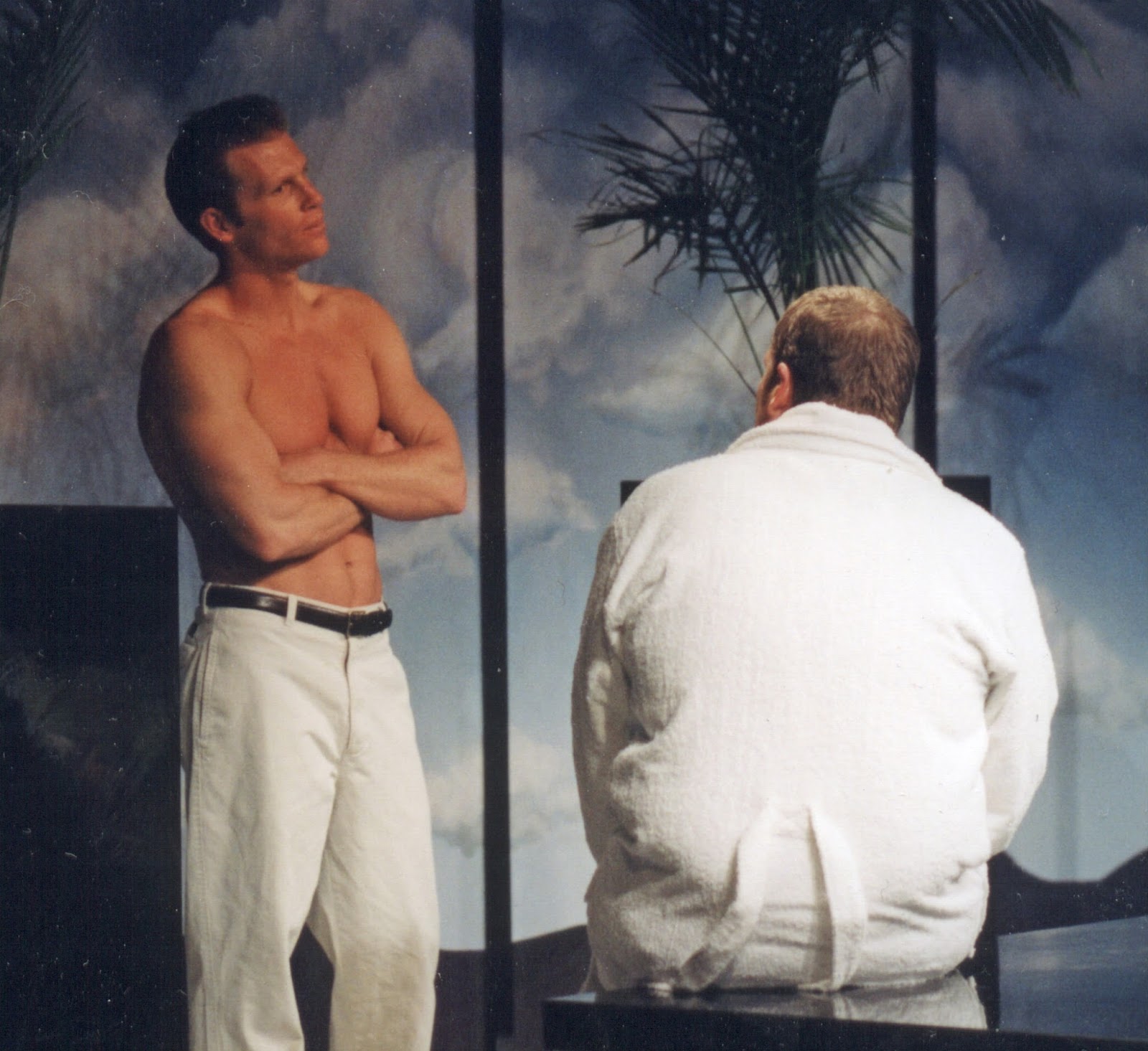
Can you guess who the gentleman with his back to us is?
If memory serves me correct, it was my first introduction to the
great Joe Bailey way back in May 2002!

Every year around Wilde Awards time I'm asked the following questions: How many reviews have we done over the years? And how many shows have I personally reviewed?

Although I've kept track of every review published by Between The Lines and/or EncoreMichigan.com from the start of my editorial career in the fall of 2001 through its end in August 2016, much of it has been in different types of documents (Word vs. Excel, for example) and in formats that varied considerably from document to document. And so because of the sheer volume of information and the differences in which it was recorded, I'd never taken the time to sort through it all and assemble the material into a single, coherent, easy-to-follow document.

Until now, that is.

And once I'd collected the information into a database that allowed me to analyze it in great detail, I decided it would be interesting to view it a number of different ways. The results, I discovered, were quite intriguing. I think you will, too - which I'll separate into two separate posts. Today's analysis will cover the years in which I first joined Between The Lines as a critic and ends with my simultaneous retirements as theater and arts editor of BTL and editorial director of EncoreMichigan.com, both of which occurred with the last review of 2014.

But first the usual caveats: Every attempt was made to be as accurate as possible while assembling this data. However, it's possible that a show or two may have been missed, or that last minute changes to our review schedule may not have been documented in the original records. As such, we apologize for any errors that may appear in this data.

The Calamia Years:


I call these "The Calamia Years" because except for my first few months at BTL during which I reported to an editor, the vast majority of my 14 years there was as an editor. As such, the decisions regarding which shows to review, preview or otherwise write about were mine. And all copy was edited by me. In other words, other than the rates paid to our freelancers, I was in control of our theater coverage - and that continued until my retirement on Dec. 20, 2014.

So how did I do?

In total, 1700 shows produced or presented by 125 companies were reviewed by 22 critics in 14 years. That averages out to approximately 121 productions per calendar year. That's pretty damn good, don't you think?

Here's the number of years for each of the 14 calendar years:

        Year     Reviews
1 2001   10
2 2002   54
3 2003   72
4 2004   97
5 2005   99
6 2006   90
7 2007   119
8 2008   103
9 2009   116
10 2010   164
11 2011   210
12 2012   187
13 2013   178
14 2014   201
1700

This next chart breaks down the number of reviews by critic. My first review for BTL was "Guys & Dolls" at Detroit's Fisher Theatre on Oct. 9, 2001 (or possibly the 10th, I'm not sure), and I was the sole critic for the first 102 reviews. John Quinn joined me almost two years later (in September 2003), and the rest - as they say - is history!

One thing you'll notice as you match this chart to the one above is that the total number of reviews don't match. That's OK; they're not supposed to, because multiple critics were used to review two years of the BoxFest Detroit Festival. As such, each critic is credited separately in the chart below.

Critic


1 Calamia 613 36.0%
2 Quinn 354 20.8%
3 Redman 168 9.9%
6 Blackburn 124 7.3%
7 Kohn 91 5.3%
8 Bethune 69 4.1%
9 Hayes-Harmer 69 4.1%
10 McKee 51 3.0%
11 Casadei 45 2.6%
12 Margolin 45 2.6%
13 Rubens 39 2.3%
14 Merrell 27 1.6%
15 Parrent 6 0.4%
16 Kennedy 2 0.1%
1703 100%

This next chart documents which theaters were reviewed and how many times we visited each. To make it easy for my readers who want to easily find their favorite theater, this chart is listed alphabetically.

Producer / Presenter
1 1515 Broadway 5
2 4Theatre Sake 1
3 7th Heaven 1
4 8th Wonder Theatre 1
5 About Face Theatre 1
6 African Renaissance Theater of Detroit 5
7 Andiamo Novi Theatre 15
8 Arbor Opera Theater 1
9 Bailiwick Repertory Theatre 1
10 Barn Theatre 15
11 Blackbird Theatre 32
12 BoarsHead Theater 38
13 BoxFest Detroit 6
14 Breathe Art Theatre Project 19
15 Broadway Grand Rapids 7
16 Broadway in Detroit: Detroit Opera House 11
17 Broadway in Detroit: Fisher Theatre 74
18 Broadway in Detroit: Masonic Temple 8
19 Broadway Onstage Live Theatre 28
20 Capital TheaterWorks 3
21 Center Stage Entertainment 1
22 Cornwell's Dinner Theatre 5
23 Detroit Actors Guild Productions 1
24 Detroit Ensemble Theatre 16
25 Detroit Repertory Theatre 42
26 Epicenter Theatre Group 3
27 Evelyn Orbach Productions 1
28 Farmers Alley Theatre 32
29 Five Cents Short 1
30 Flanders Theater Company 4
31 Flint Youth Theatre 3
32 Fratellanza 1
33 Front Row Productions 1
34 Gem & Century Theatres 30
35 George Productions 1
36 Go Comedy! Improv Theater 51
37 Great Escape Stage Company 8
38 Henry Ford College's Virtual Theatricality Lab 1
39 Hilberry Theatre 87
40 Hole in the Wall Theatre Company 1
41 Hope Summer Repertory Theatre 25
42 Improv Inferno 8
43 Ixion 2
44 Khoros, Inc. 1
45 LCC Theatre 1
46 Macomb Center for the Performing Arts 1
47 Magenta Giraffe Theatre Company 16
48 Mason Street Warehouse 17
49 Matrix Theatre Company 20
50 Meadow Brook Theatre 77
51 Michigan Actors Studio 3
52 Michigan Opera Theatre 20
53 Michigan Shakespeare Festival 26
54 Miller Auditorium 2
55 Mixed Company Troupe 1
56 Mosaic Youth Theatre of Detroit 1
57 Motoprism 1
58 Music Hall Center for the Performing Arts 2
59 Nerve 1
60 New York Dinner Theater 1
61 Nieto Productions 2
62 NoSuch Group 1
63 Olympia Entertainment & The Ringwald 1
64 Olympia Entertainment: City Theatre 19
65 Olympia Entertainment: Fox Theatre 15
66 Olympia Entertainment: Joe Louis Arena 2
67 Open Book Theatre Company 2
68 Palace of Auburn Hills 1
69 Performance Network Theatre 79
70 Phases Theatre Company 2
71 Pigeon Creek Shakespeare Company 12
72 Planet Ant Theatre 113
73 Play with Your Food Dinner Theatre 1
74 Plowshares Theatre Company 21
75 PuppetART 4
76 Puzzle Piece Theatre 4
77 Riverbank Theatre 1
78 Shakespeare in Detroit 2
79 Shop Floor Theatre Company 1
80 Slipstream Theatre Initiative 1
81 StarBrite Theatrical Productions 20
82 Stark Turn Players 1
83 Stormfield Theatre 8
84 Stratford Shakespeare Festival 12
85 Summer Circle Theatre 5
86 The Abreact 42
87 The Acorn Theater 1
88 The Actors' Company 3
89 The AKT Theatre Project 6
90 The Bach Dor Shakespeare Company 1
91 The Box Theater 26
92 The Dio - Dining & Entertainment / Dionysus Theatre 10
93 The Elizabeth Theater Company / Park Bar Theater 6
94 The Encore Musical Theatre Company 32
95 The Hinterlands 1
96 The Jewish Ensemble Theatre Company 66
97 The Last Word LLC 1
98 The Music Box at The Max / Detroit Symphony Orchestra 1
99 The New Theatre Project 8
100 The Penny Seats Theatre Company 1
101 The Purple Rose Theatre Company 49
102 The Ringwald Theatre / Who Wants Cake? Theatre 75
103 The Second City - Detroit 24
104 The Snug Theatre 11
105 Theatre 1 1
106 Thick Knot Rhythm Ensemble 3
107 Threefold Productions 3
108 Tibbits Opera House / Tibbits Summer Theatre 21
109 Tipping Point Theatre 36
110 TNT Productions 3
111 Torch With a Twist 1
112 Two Muses Theatre 13
113 UDM Theatre Company 37
114 Uncovered Theatre Company 1
115 University Musical Society 4
116 Van Buren Street Theatre 1
117 Walk & Squawk Performance Project 3
118 Water Works Theatre Company 8
119 West End Productions 1
120 Wharton Center for the Performing Arts 13
121 What A Do  Theatre 14
122 Wild Swan Theater 2
123 Williamston Theatre 46
124 Y-Arts Detroit 1
125 Zeitgeist Theatre 6
1700

Today's final chart presents the same data as the chart above, but sorted by the number of times we reviewed at each theater, from the most visits to the least. Would you have guessed the Top 5 theaters in the following sequence?

Producer / Presenter
1 Planet Ant Theatre 113
2 Hilberry Theatre 87
3 Performance Network Theatre 79
4 Meadow Brook Theatre 77
5 The Ringwald Theatre / Who Wants Cake? Theatre 75
6 Broadway in Detroit: Fisher Theatre 74
7 The Jewish Ensemble Theatre Company 66
8 Go Comedy! Improv Theater 51
9 The Purple Rose Theatre Company 49
10 Williamston Theatre 46
11 Detroit Repertory Theatre 42
12 The Abreact 42
13 BoarsHead Theater 38
14 UDM Theatre Company 37
15 Tipping Point Theatre 36
16 Blackbird Theatre 32
17 Farmers Alley Theatre 32
18 The Encore Musical Theatre Company 32
19 Gem & Century Theatres 30
20 Broadway Onstage Live Theatre 28
21 Michigan Shakespeare Festival 26
22 The Box Theater 26
23 Hope Summer Repertory Theatre 25
24 The Second City - Detroit 24
25 Plowshares Theatre Company 21
26 Tibbits Opera House / Tibbits Summer Theatre 21
27 Matrix Theatre Company 20
28 Michigan Opera Theatre 20
29 StarBrite Theatrical Productions 20
30 Breathe Art Theatre Project 19
31 Olympia Entertainment: City Theatre 19
32 Mason Street Warehouse 17
33 Detroit Ensemble Theatre 16
34 Magenta Giraffe Theatre Company 16
35 Andiamo Novi Theatre 15
36 Barn Theatre 15
37 Olympia Entertainment: Fox Theatre 15
38 What A Do  Theatre 14
39 Two Muses Theatre 13
40 Wharton Center for the Performing Arts 13
41 Pigeon Creek Shakespeare Company 12
42 Stratford Shakespeare Festival 12
43 Broadway in Detroit: Detroit Opera House 11
44 The Snug Theatre 11
45 The Dio - Dining & Entertainment / Dionysus Theatre 10
46 Broadway in Detroit: Masonic Temple 8
47 Great Escape Stage Company 8
48 Improv Inferno 8
49 Stormfield Theatre 8
50 The New Theatre Project 8
51 Water Works Theatre Company 8
52 Broadway Grand Rapids 7
53 BoxFest Detroit 6
54 The AKT Theatre Project 6
55 The Elizabeth Theater Company / Park Bar Theater 6
56 Zeitgeist Theatre 6
57 1515 Broadway 5
58 African Renaissance Theater of Detroit 5
59 Cornwell's Dinner Theatre 5
60 Summer Circle Theatre 5
61 Flanders Theater Company 4
62 PuppetART 4
63 Puzzle Piece Theatre 4
64 University Musical Society 4
65 Capital TheaterWorks 3
66 Epicenter Theatre Group 3
67 Flint Youth Theatre 3
68 Michigan Actors Studio 3
69 The Actors' Company 3
70 Thick Knot Rhythm Ensemble 3
71 Threefold Productions 3
72 TNT Productions 3
73 Walk & Squawk Performance Project 3
74 Ixion 2
75 Miller Auditorium 2
76 Music Hall Center for the Performing Arts 2
77 Nieto Productions 2
78 Olympia Entertainment: Joe Louis Arena 2
79 Open Book Theatre Company 2
80 Phases Theatre Company 2
81 Shakespeare in Detroit 2
82 Wild Swan Theater 2
83 4Theatre Sake 1
84 7th Heaven 1
85 8th Wonder Theatre 1
86 About Face Theatre 1
87 Arbor Opera Theater 1
88 Bailiwick Repertory Theatre 1
89 Center Stage Entertainment 1
90 Detroit Actors Guild Productions 1
91 Evelyn Orbach Productions 1
92 Five Cents Short 1
93 Fratellanza 1
94 Front Row Productions 1
95 George Productions 1
96 Henry Ford College's Virtual Theatricality Lab 1
97 Hole in the Wall Theatre Company 1
98 Khoros, Inc. 1
99 LCC Theatre 1
100 Macomb Center for the Performing Arts 1
101 Mixed Company Troupe 1
102 Mosaic Youth Theatre of Detroit 1
103 Motoprism 1
104 Nerve 1
105 New York Dinner Theater 1
106 NoSuch Group 1
107 Olympia Entertainment & The Ringwald 1
108 Palace of Auburn Hills 1
109 Play with Your Food Dinner Theatre 1
110 Riverbank Theatre 1
111 Shop Floor Theatre Company 1
112 Slipstream Theatre Initiative 1
113 Stark Turn Players 1
114 The Acorn Theater 1
115 The Bach Dor Shakespeare Company 1
116 The Hinterlands 1
117 The Last Word LLC 1
118 The Music Box at The Max / Detroit Symphony Orchestra 1
119 The Penny Seats Theatre Company 1
120 Theatre 1 1
121 Torch With a Twist 1
122 Uncovered Theatre Company 1
123 Van Buren Street Theatre 1
124 West End Productions 1
125 Y-Arts Detroit 1

1700